
IV stem cell therapy in Istanbul: how the infusion works
What the intravenous route is, why our medical team may select it, how the infusion day runs, and what we monitor while you are with us.

Intravenous Stem Cell Therapy at Our Istanbul Clinic
This page explains what intravenous stem cell therapy is, how our medical team plans it, and what treatment in Istanbul involves. It is general information rather than a treatment plan: suitability is confirmed only after our team has reviewed your diagnosis, your records, the alternatives open to you, and the goals you want treatment to support.
At a glance
Intravenous Stem Cell Therapy at a glance
- Biological material
- A cell product given into the bloodstream. The product, the dose and the infusion method are named in your treatment plan.
- How it is given
- Intravenous infusion, with a defined observation and monitoring period and stated emergency arrangements.
- Where it sits today
- The evidence differs for each condition, product, dose and study design, so the route on its own does not make a treatment appropriate.
- Who it may suit
- That is decided case by case. This page explains the treatment; suitability is confirmed only after our medical team has reviewed your records.
Where an intravenous infusion travels
An intravenous infusion places the preparation into the circulation. The image follows that route through the body and shows the monitoring that sits around the infusion itself.
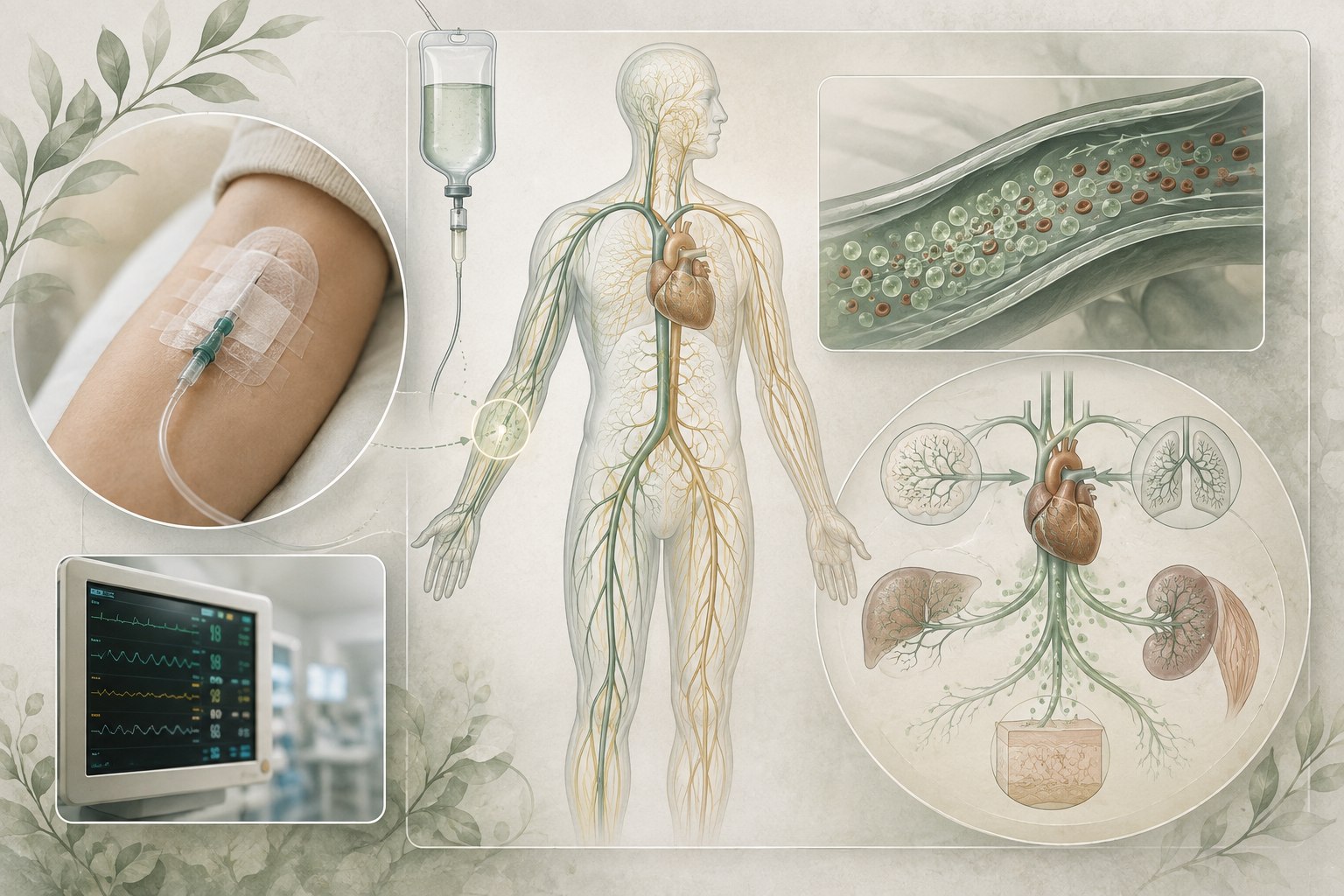
Clinical context
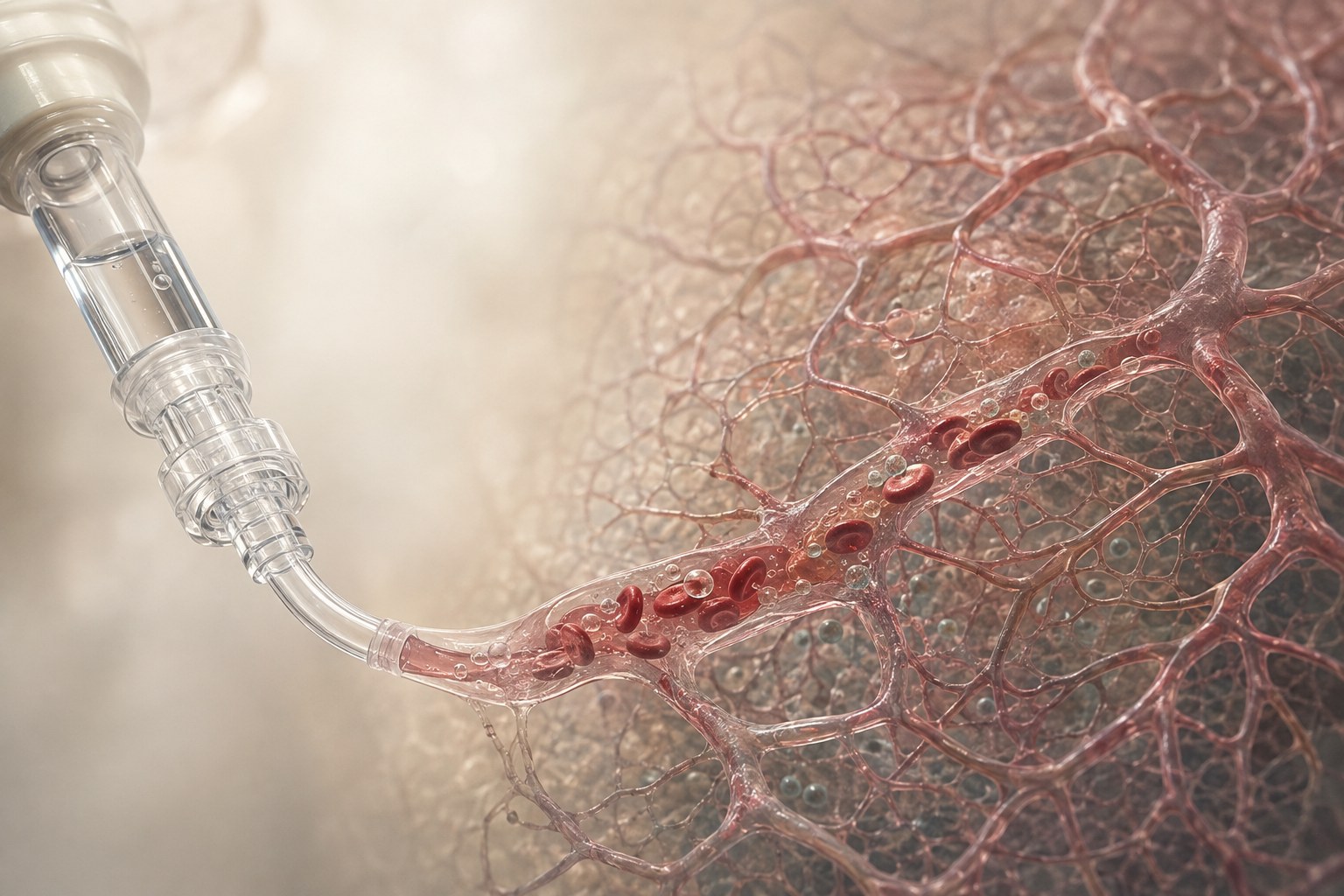
Microscopic research viewIllustrative detail
- Into the circulation
- An intravenous preparation passes first through the veins, heart, and lungs rather than traveling straight to one organ.
- Infusion safety
- Identity, dose, suspension, sterility, line care, vital signs, and the response to any reaction follow a written protocol.
- What the route is for
- The rationale for this route is systemic immune and paracrine signaling, which is different from delivering cells into a specific tissue.
What Is Intravenous Stem Cell Therapy?
Intravenous administration means the cell preparation goes into a vein through a soft cannula, much as a routine drip is given, and travels with the bloodstream. Patients call it a stem cell infusion, a stem cell IV or a stem cell drip. All three describe the delivery method rather than what is in the bag, which is why your plan names the product as well as the route. In our program that product is mesenchymal stromal cells from Wharton's jelly, the gelatinous tissue inside a donated umbilical cord.
Our team selects this route when the treatment goal is systemic: when the aim is to reach the body broadly rather than one joint, one tendon or one part of the nervous system. Once in the circulation the preparation passes through the lungs first, and where the cells travel after that is still being worked out in research. It is a route chosen for a type of goal, not a route that outranks the others.
On the day, a nurse places the cannula and the preparation is checked against its batch documentation. A physician supervises an infusion given slowly over a set period, your vital signs are monitored throughout, and you stay for an observation period afterwards. Our team gives you written instructions for the rest of the day, tells you what to report and when, and confirms when travel is reasonable. Speak with our patient coordination team about planning an infusion visit, and you will have the full schedule before you book anything.
How Intravenous Stem Cell Therapy Works
These are the biological ideas intravenous stem cell therapy is built on. How much of it applies to you depends on your diagnosis, the goals set during your case review, the route of administration and the rest of your clinical picture, which is what our medical team works through with you.
- The preparation enters the circulation and is carried through the body, and the lungs are the first tissue it passes through
- The reason a systemic route is studied at all is the signalling: cells release biological messages that influence the cells around them, known as paracrine signalling
- Among those messages are cytokines, the proteins cells use to communicate with the immune system, and research follows what the inflammatory response does afterwards
- Shifting immune behaviour rather than shutting it down, called immunomodulation, is the property most often investigated for this route
- No route is superior in itself: the intravenous route suits a systemic goal, while a problem confined to one structure is usually addressed where it sits
- Infusion rate, volume, premedication and monitoring are written into the plan rather than decided on the day
Stem cells and exosomes are different.
One is a living cell. The other is a cell-derived messenger. The difference shapes how each is sourced, how it is given, and which one our medical team may propose for your case.
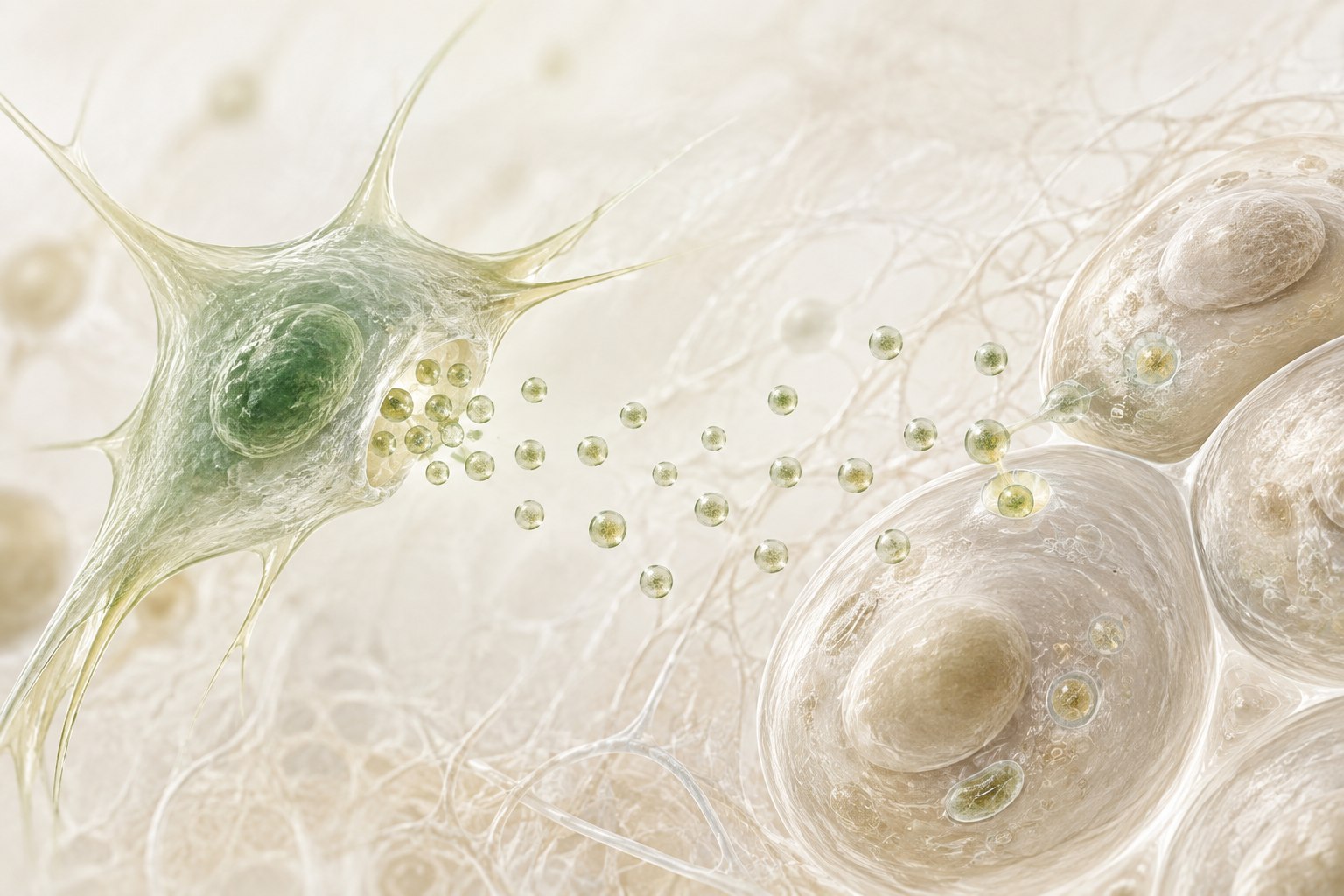
- 01 / SOURCE
Living source cells
Mesenchymal stromal cells are living cells. Their behavior depends on source, handling, dose, and biological context.
- 02 / SIGNAL
Released signals
Cells release soluble factors and extracellular vesicles. Exosomes are one subset of these small vesicles.
- 03 / RESPONSE
Local cell response
Nearby cells may respond to those signals. That biological rationale is where treatment planning starts, not a promise of a result.
Your case review
How Our Medical Team Assesses Suitability
The purpose of the review is clarity. Your diagnosis, medical history, reports, imaging, current medication and the goals that matter to you give our team the context to plan treatment, or to tell you that this route is not right for your case.
- A treatment goal that is systemic rather than confined to one joint, tendon or nerve
- Autoimmune, inflammatory or metabolic conditions documented in recent reports and under specialist care
- Suitable venous access and cardiopulmonary fitness, assessed by our medical team before the plan is confirmed
- Fitness to travel to Istanbul and to stay for the infusion and the observation period that follows
- Suitability is confirmed after review of allergies, clotting and immune history, infection risk, current medication and other infusion contraindications
Setting Realistic Goals for Your Treatment
Before treatment we agree on what we are aiming for: measures that fit your condition, a realistic period over which to review them, and what would count as no meaningful change. Goals are not predictions. Responses vary between patients and no clinical outcome can be guaranteed.
- The goal is agreed before the infusion and expressed in terms that can be reviewed, such as symptom scores or the measures your specialist already uses
- General symptoms such as energy, mood and sleep fluctuate for many reasons, so they are recorded rather than taken as proof of effect
- Laboratory markers are followed where they are relevant to the diagnosis, alongside how you actually feel and function
- What happens after the infusion is agreed in advance: the review point, what is measured, and how your own clinician is kept informed
- Regenerative medicine is planned individually: responses vary between patients, no clinical outcome can be guaranteed, suitability is confirmed only after medical review, and treatment is planned alongside your existing care
Your next step
Find out whether intravenous stem cell therapy may suit your case
If intravenous stem cell therapy looks relevant to your diagnosis, the next step is a review of your own records by our medical team. If it does not, we can explain which of the other routes we plan may fit better.
Suitability is confirmed only after our medical team has reviewed your records, and treatment is planned alongside the care you already receive.
From Your Records to an Agreed Treatment Plan
How our team moves from your first records review to a plan you can act on: evidence, risk, practical detail and follow-up, settled before you travel.
Send your medical records
Recent reports, imaging, your current medication, and what you hope treatment will help with. It lets our medical team make the review specific to you.
Start your case reviewSend your medical records
Our patient coordination team starts with your confirmed diagnosis, recent reports and imaging, current medications, previous procedures, and the outcomes that matter most to you.
Medical case review
Our medical team reads the file and decides whether this pathway is relevant to your case, which route would suit it, and where your existing care should stay in the lead.
Read your written treatment plan
You receive the biological material proposed and its documentation, the preparation and dose, the route, the schedule, the monitoring, the risks, the alternatives, and an itemized cost, in writing.
Plan your treatment in Istanbul
We confirm appointment timing, how long to stay, airport transfers, accommodation, mobility needs, medication instructions and your local contact before you book travel.
Stay in contact after you go home
Before treatment we agree what will be measured, when it will be reviewed, who answers your questions once you are home, and how your own clinician is kept informed.
Intravenous Stem Cell Therapy - Frequently Asked Questions
Does the infusion hurt?
Placing the cannula feels like a routine blood test, and the infusion itself is usually not painful. Some patients notice warmth, a flush or mild fatigue. Our team monitors your vital signs throughout and tells you which sensations to report straight away.
How long does an infusion day take in Istanbul?
Preparation, the infusion itself and the observation period afterwards make up the day, and the exact length depends on the product, the dose and how you respond. Your written schedule gives the timing before you book travel.
How many infusions will I need?
Your plan states the number proposed and the reason for each one. Further sessions are considered at the review point, based on what the agreed measures show, rather than booked as a standing course.
Can I fly home the same day?
Usually not, and we would rather you did not. Our team gives written fit-to-travel guidance after the observation period, taking account of the infusion, your medical history and the length of your flight.
What is monitored during and after the infusion?
Blood pressure, pulse, temperature, oxygen saturation and how you are feeling, at intervals through the infusion and during the observation period that follows. Any reaction is managed on site, and what happened is written into your discharge information.
Which treatment goals is the IV route usually chosen for?
Goals that involve the body as a whole rather than one structure, which is why it is the route most often planned for autoimmune, inflammatory and metabolic conditions. Where symptoms come from a single joint or tendon, our team will usually propose a targeted injection instead.
How do I find out whether I may be suitable for treatment in Istanbul?
Send your confirmed diagnosis, recent reports and imaging, current medications and medical history to our patient coordination team. Our medical team reviews suitability case by case and tells you in writing whether this pathway fits your situation, and what it would involve.
How long do international patients stay in Istanbul?
It depends on the plan our medical team proposes: the procedure, the route, the monitoring, your mobility and the follow-up all affect it. Your written schedule states the number of days before you book flights or accommodation.
Is this treatment safe?
No medical treatment is free of risk, and we are direct about that. Our team reduces the risks that can be reduced: screened donor material, batch testing before release, administration by a physician in a clinical setting, monitoring during and after the procedure, and a written account of the side effects and contraindications that apply to your plan.
What results can I expect?
Your plan states a therapeutic goal and how it will be measured, not a promised outcome. Our medical team explains what change would be meaningful in your case, when it will be reviewed, and what we would do next if that review shows no benefit.
How much does treatment cost in Istanbul?
Pricing is case-specific: the material, the preparation and dose, the route, the number of sessions, the monitoring and any travel services all affect it. Our patient coordination team sends an itemized written estimate so you can see what each part of the plan costs before you commit.
What does the international patient program include?
Your estimate lists the medical review, tests, the procedure itself, monitoring, medications, airport transfers, accommodation arrangements, written discharge information and follow-up as separate lines, so you can see what is included and what is not.
How this guide is maintained
How This Guide Is Written and Reviewed
Editorial reviewHow this guide is reviewed
This guide carries a last-reviewed date. Review asks whether the way we describe intravenous stem cell therapy and the research behind it still matches the published literature.
Where the evidence is limited, mixed or still emerging, the page says so rather than settling the question in the treatment's favour.
SourcingWhat we count as a source
Peer-reviewed human studies, trial registry entries and regulatory guidance. Laboratory and animal work is labelled as preclinical, and individual case reports are described as case reports.
Marketing material, including our own, is not treated as evidence.
Your treatment planWhat our medical team sets out
Before you agree to anything, our team can set out in writing the material proposed for your plan, how it is sourced, processed and release-tested, the route of administration, the monitoring plan, the full cost with exclusions, and who is clinically responsible for your care.
If any part of that is unclear, ask us. Your plan should make sense to you before you travel.

Evening on the Bosphorus, with a ferry and the bridge beyond. It shows the city you would travel to, not our clinic, your accommodation, or a service included in a plan.
Plan the Istanbul day around infusion monitoring
We confirm the preparation, infusion duration, vascular access, observation period, what happens if you react, medication guidance, and follow-up before you travel.
Keep researching
Related Treatments and Conditions for Intravenous Stem Cell Therapy
Treatment
Umbilical Cord MSC Therapy
The cord-tissue mesenchymal cells we work with, from donor screening to batch release testing.
Learn more→
Treatment
Stem Cell Therapy
Our MSC-based treatment in Istanbul: the cells we use, how a plan is built, and what treatment involves.
Learn more→
Treatment
Intrathecal Stem Cell Therapy
Delivery into the spinal canal: how the procedure is performed, how patients are monitored, and its risks.
Learn more→
Treatment
Longevity Program
Our age-management program in Istanbul: what it includes, and what each component is intended to support.
Learn more→
Condition
Multiple Sclerosis (MS)
How regenerative medicine is planned for Multiple Sclerosis (MS) at our Istanbul clinic.
Learn more→
Condition
Rheumatoid Arthritis
How regenerative medicine is planned for Rheumatoid Arthritis at our Istanbul clinic.
Learn more→
Condition
Lupus (Systemic Lupus Erythematosus)
How regenerative medicine is planned for Lupus (Systemic Lupus Erythematosus) at our Istanbul clinic.
Learn more→
Condition
Diabetes
How regenerative medicine is planned for Diabetes at our Istanbul clinic.
Learn more→
Condition
Chronic Obstructive Pulmonary Disease (COPD)
How regenerative medicine is planned for Chronic Obstructive Pulmonary Disease (COPD) at our Istanbul clinic.
Learn more→
Condition
Liver Failure
How regenerative medicine is planned for Liver Failure at our Istanbul clinic.
Learn more→
More from our clinic
Planning your intravenous stem cell therapy in Istanbul
The practical side of treatment at our clinic: what the research shows, who may be suitable, what a plan costs, and how your stay in Istanbul and your follow-up are arranged.
Cost, Outcomes & Istanbul
- Visit our Istanbul clinicWhere we are, how patients reach us, and what to arrange before you travel.
- Understand treatment pricingWhat shapes a quote, and what an itemized estimate from our clinic covers.
- Planning your Istanbul treatment tripRecords, travel timing, local transport, accommodation, and follow-up after you fly home.
- Choosing a stem cell clinic in IstanbulHow we document candidacy, pricing, clinical oversight, and aftercare for international patients.
- Rules and oversight in TurkeyHow regenerative medicine is regulated in Türkiye, and the paperwork that accompanies treatment.
- Reading stem cell success ratesWhat a published percentage can and cannot tell you about your own diagnosis.
- What your treatment quote includesWhat the clinical fee covers, which items are listed separately, and what moves the total.
- What to expect during treatmentThe remote case review, your written plan, the treatment day, and follow-up once you are home.
- Longevity and healthy-ageing care in IstanbulWhat our longevity programme assesses, and how it differs from treating a diagnosed condition.
- What exosome treatment in Istanbul costsHow we structure an exosome quote, and the line items a written estimate names.
- Exosome therapy questions we are askedSourcing, dosing, regulation, and the documentation that accompanies a proposed treatment.
- Medical travel to Turkey: patient guideHow remote record reviews, clinic scheduling, and travel logistics fit together.
- Comparing treatment abroad: Turkey vs MexicoQuestions to ask when comparing clinics, cell documentation, and oversight across countries.
Condition guides
Treatments & the science
- Stem Cell Therapy Overview
- Introduction to Stem Cell Therapy
- Umbilical Cord Stem Cells (UC-MSCs)
- Mesenchymal Stem Cell (MSC) Therapy
- How Stem Cells Work
- Safety & Treatment Process
- Exosome Therapy Overview
- How Exosomes Work
- Stem Cells vs Exosomes
- Intravenous (IV) Stem Cell Therapy
- Intrathecal Stem Cell Therapy
- Longevity Program
- See all treatments →
International patient support
Talk to our medical team about Intravenous Stem Cell Therapy.
Send your diagnosis, reports, imaging and current medication. Our medical team explains which options may fit your case, what the treatment involves, and what your stay in Istanbul would look like.
Nothing needs to be booked to begin. Our patient coordination team plans your visit to Istanbul once your treatment plan is agreed.