
Stem Cell Therapy for ALS in Istanbul, Turkey
How our medical team assesses ALS, what an intravenous or intrathecal treatment plan involves, and how families start a case review from abroad.

Understanding Amyotrophic Lateral Sclerosis (ALS)
Amyotrophic lateral sclerosis (ALS) is a progressive disease of the motor neurons, the nerve cells in the brain and spinal cord that carry instructions to muscle. It is called motor neurone disease (MND) in much of the world and Lou Gehrig's disease in the United States. As those neurons are lost, muscles weaken and speech, swallowing, movement and breathing gradually become harder.
What a regenerative plan is aimed at in ALS is the environment the surviving motor neurons are working in. Inflammation in nervous tissue and a shortage of the growth signals that keep nerve cells alive are both part of that picture, and both are squarely what mesenchymal stromal cells (MSCs) are studied for: these cells release biological signals that influence the cells nearby, a process called paracrine signalling. Ours come from Wharton's jelly, the gelatinous tissue inside the umbilical cord, and that young perinatal source is chosen for how strongly these cells signal rather than for anything they are expected to become. The research here centres on inflammation around motor neurons and on growth factors that help nerve cells survive, known as neurotrophic signalling. Human work in ALS is still at an early stage, so our team explains that rationale and the plan built on it rather than a predicted result.
For ALS, our medical team starts with the neurology record: time since diagnosis, how quickly function has changed, EMG findings, breathing and swallowing status, medication and how much travel can safely be managed. Treatment is planned around the multidisciplinary care you already have - respiratory, nutrition, speech and mobility support all continue. The aim may focus on comfort, daily function and quality of life, written down with you before anything is arranged. Families can begin by sending recent neurology reports for a medical case review, with no commitment to travel attached.
How Amyotrophic Lateral Sclerosis (ALS) Can Affect Daily Life
Symptoms, severity and progression vary from person to person. Our medical team uses this kind of detail as context for your case review; it is not a diagnostic checklist. Diagnosis, and any change in your symptoms, belong with the clinician who knows your medical history.
- Progressive muscle weakness, especially in hands, arms or legs
- Muscle twitching or fasciculations
- Slurred or unclear speech
- Difficulty swallowing or chewing
- Reduced grip, walking ability or fine motor control
- Breathing weakness in more advanced stages
ALS across the motor system
ALS affects a connected motor system rather than one isolated symptom. This illustration links the anatomy our neurology review follows with the everyday functions that matter most to you.
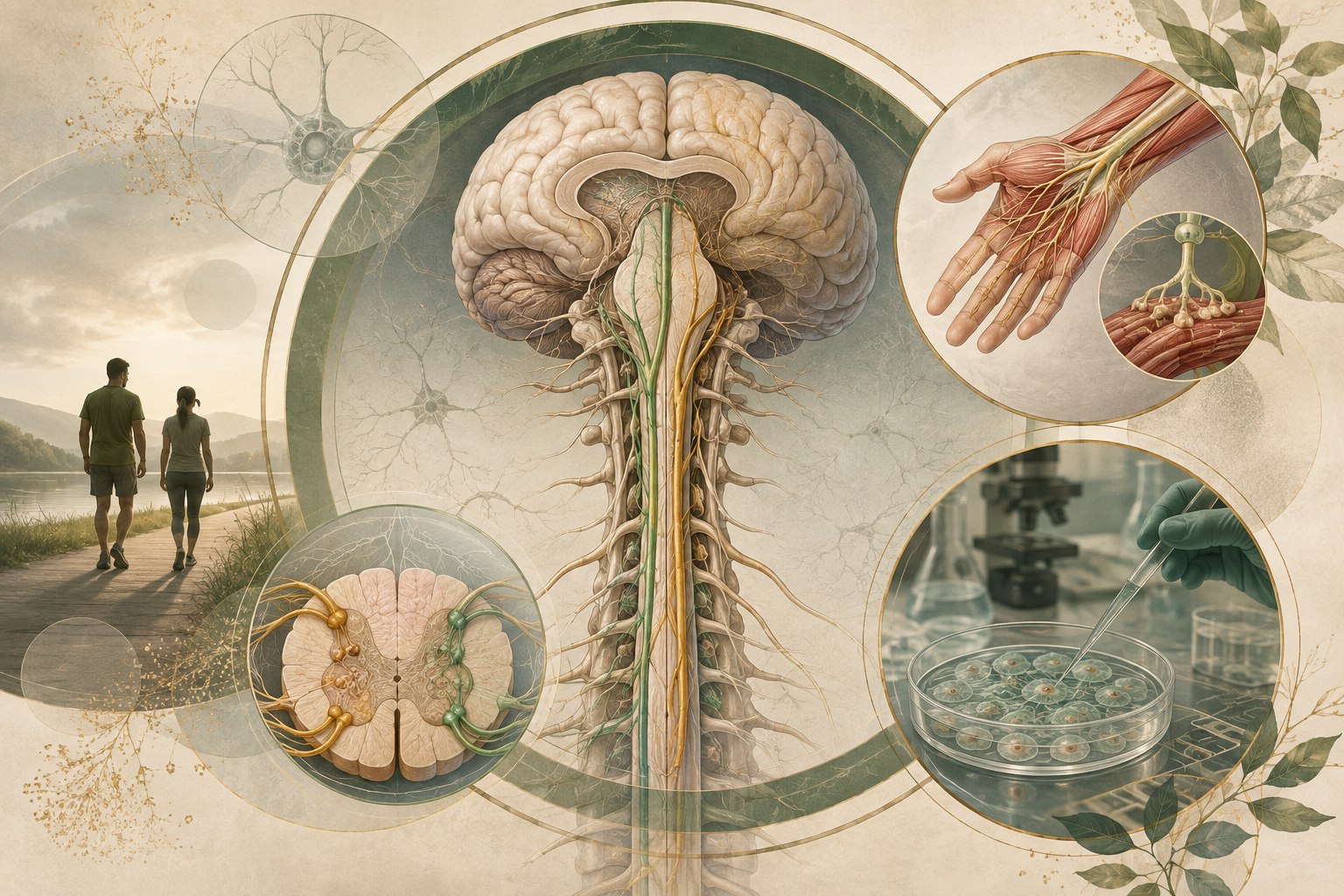
Clinical context
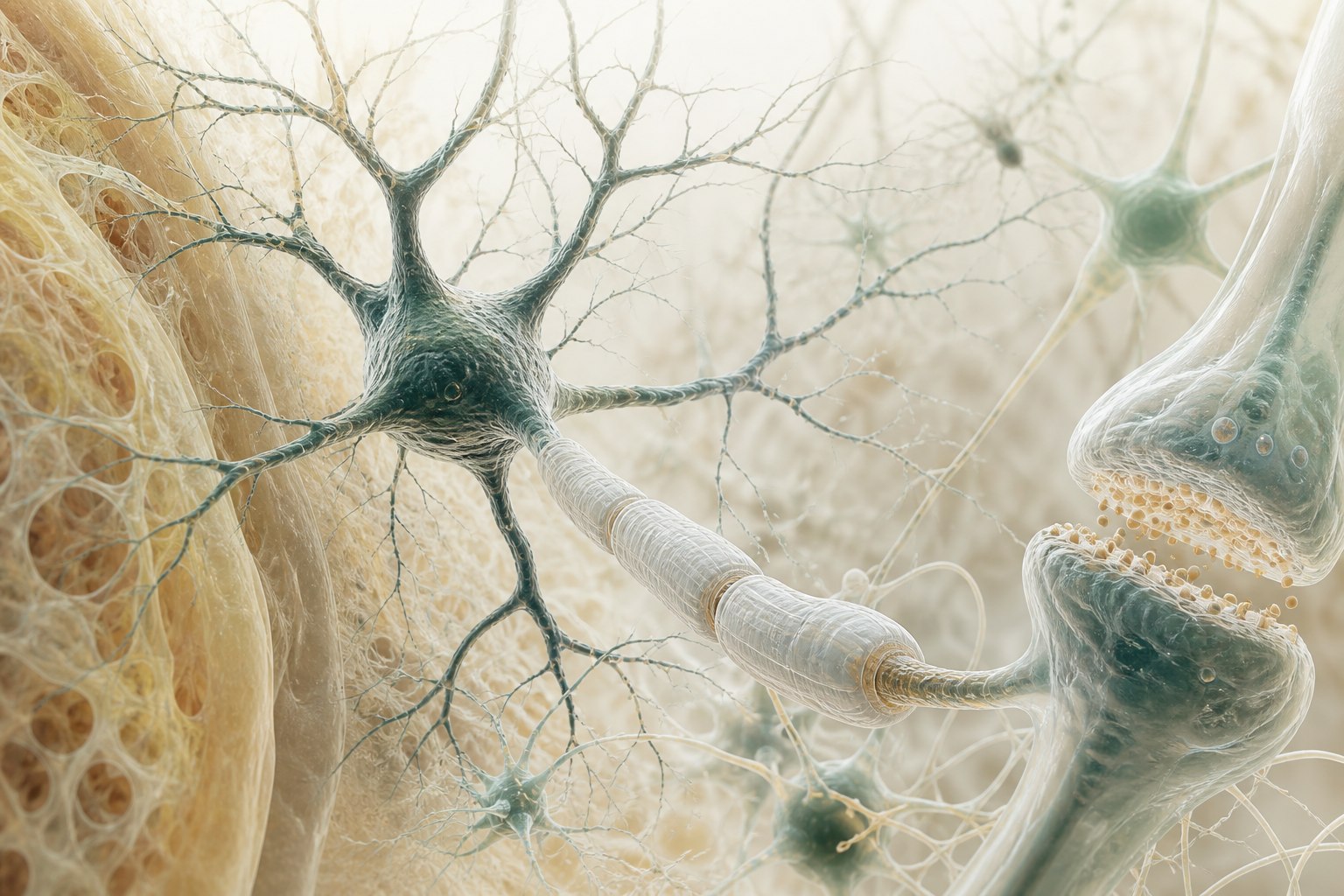
Microscopic research viewIllustrative detail
- Motor neuron pathway
- Signals travel from the brain through the spinal cord to muscles used for movement, speech, swallowing, and breathing.
- Function in daily life
- Grip, walking, communication, nutrition, and breathing tell our medical team more about your situation than a single symptom score.
- Coordinated support
- Anything we plan is built alongside your neurology, respiratory, nutrition, mobility, and communication care, never in place of it.
Why Regenerative Medicine Is Being Studied in ALS
These are the biological mechanisms researchers are investigating. A mechanism is a reason to study a treatment, not a promise of benefit for an individual patient. Our medical team will explain how much of this research applies to your own diagnosis.
- What these cells are studied for above all is what they release: biological signals that influence the cells around them, a process called paracrine signalling
- In ALS the research interest is the environment around motor neurons: inflammation in nervous tissue, and growth factors that support nerve cell survival (neurotrophic signalling)
- Injected cells are not described as travelling to the spinal cord and becoming new motor neurons; the research describes signalling, not replacement
- Intravenous infusion and intrathecal administration into the fluid around the spinal cord reach different compartments, and your plan states which is proposed and why
- The aim may focus on comfort, daily function and quality of life rather than on the course of the disease itself
- Our team commits to a written plan and to measuring it, and will say when treatment is not appropriate
Research maturity
What the Research Currently Shows for ALS
How far published research has travelled for each approach, from laboratory work through to established standard care. It describes the maturity of the evidence, not how well any option works and not what to expect in an individual case.
- 01Laboratory and animal work
- 02Early human studies
- 03Controlled trials under way
- 04Established standard of care
Multidisciplinary ALS care
Respiratory, nutritional, communication, mobility and palliative support, which changes outcomes that matter to patients.
Established standard of care
Mesenchymal stromal cells for ALS
Early-phase trials have examined safety and feasibility. None has shown slower progression, restored function or longer survival.
Early human studies
Your case review
How Our Medical Team Reviews Your Case
Your review starts with the confirmed diagnosis, recent reports and imaging, current treatment, medical history, and the outcome that matters most to you. Not everyone is suitable for regenerative medicine, and our team will say so when the care you already receive is the better route.
- A confirmed ALS or MND diagnosis, with recent neurology notes and EMG results for our team to read
- Current breathing and swallowing status, which shapes whether travel and treatment are safe
- A full medication list, including riluzole or any trial participation, reviewed for timing and interactions
- Goals agreed with the patient and family, described as aims rather than promised gains
- A caregiver or family member able to travel where support is needed
- A follow-up plan shared with your neurology and respiratory teams at home
How Treatment for ALS Is Planned at Our Istanbul Clinic
The path international patients follow with us, from the first review of your records to follow-up after you return home. The exact steps depend on what your medical review finds.
Send your medical records
Recent reports, imaging, your current medication, and what you hope treatment will help with. It lets our medical team make the review specific to you.
Start your case reviewSend your medical records
Your case review starts with the confirmed diagnosis, recent reports and imaging, current medications, previous procedures and the outcomes that matter most to you. Everything can be sent digitally from home, long before travel is discussed.
Case review by our medical team
Our medical team reads the file against your diagnosis, disease stage, imaging, laboratory results, current treatment and any contraindications, then decides whether regenerative medicine is appropriate for you and which goals are realistic to discuss.
Your written treatment plan
When treatment is appropriate, you receive the plan in writing: the cell material and how it is prepared, the dose, the route of administration, the number of sessions, the monitoring involved and an itemized cost with no assumed extras.
Your treatment in Istanbul
On arrival our team repeats the checks that matter for your case, confirms the plan with you, and carries out treatment under medical supervision with an observation period afterwards. Your coordinator handles scheduling, timings and what each day involves.
Follow-up and monitoring
Before you fly home we agree what will be measured, when it will be reviewed and how to reach us. Follow-up continues remotely and can be shared with your own doctors, so your treatment plan and your local care stay aligned.
Your treatment plan
What Our Medical Team Explains Before You Decide
"Stem cells" and "exosomes" name a category, not a specific product. What matters in your plan is the source of the material, how it was prepared, the route and the dose, the clinical setting, and why you were considered suitable. Our medical team sets each of those out for the treatment being proposed to you.
We plan treatment alongside the care you already receive, so keep your own clinician involved and record a clear baseline before you travel. For the practical side, read the Istanbul treatment trip guide and the cost guide, then ask us for an itemized estimate.
- Which published research applies to your diagnosis and to the route we propose.
- Where the biological material comes from, how it is prepared, and how it is documented.
- The possible side effects and the contraindications that apply to your procedure.
- Which functional outcome is measured before treatment and again at follow-up.
- How treatment sits alongside your existing care, including the option of not treating.
- Who to contact about follow-up, or about a complication, once you are home.
- What your estimate includes and excludes, and what is due before you travel.
Next step
Start with a medical case review
Send your diagnosis, recent reports, imaging and current medication, and tell us what you want treatment to help with.
Amyotrophic Lateral Sclerosis (ALS): Questions Patients Ask Us
What determines the cost of stem cell therapy for ALS in Istanbul, Turkey?
The route is the largest single factor, because an intrathecal procedure involves procedure-room time, imaging and a recovery period that an infusion does not. Your written quote itemizes the neurology review, the number of sessions, respiratory monitoring, mobility assistance and accompanying-caregiver arrangements separately, and states what it excludes.
Which route of administration is used for ALS at your clinic?
Both intravenous infusion and intrathecal administration are used in ALS research, and they are not interchangeable. Our medical team selects the route from your respiratory status, spinal anatomy, medication, bleeding risk and how much time you can spend in the procedure room, then sets out the reasoning and the specific risks in your plan.
Can treatment be considered in advanced ALS?
Advanced disease changes the assessment rather than ending it. Breathing capacity, swallowing safety, pressure-injury risk, seating and transfer needs and overall stability all decide whether a trip to Istanbul is reasonable. Where travel would cost more than it could return, our team says so and suggests continuing care closer to home.
What happens after ALS treatment in Istanbul?
Before you fly home we agree the measures that will be tracked - function, breathing, speech, weight and the daily tasks that matter to you - and when they will be reviewed. Follow-up continues remotely with our medical team and can be shared with your neurologist so the two plans stay aligned.
Are Wharton's jelly stem cells used to treat Amyotrophic Lateral Sclerosis (ALS) in Istanbul?
Yes. Our regenerative medicine program works with mesenchymal stromal cells (MSCs) grown from Wharton's jelly, the gelatinous tissue inside the umbilical cord. It is donated after a healthy birth with written maternal consent, from tissue that would otherwise be discarded, so nothing is taken from mother or baby and none of the ethical questions attached to embryonic sources arise. Because these cells expand readily in culture, a batch is characterised and release-tested before it reaches anyone. Your written plan names the material, how it is prepared, the dose, the route of administration and the schedule, and our medical team explains why each of those was chosen for your case.
Why use donor cells from Wharton's jelly rather than my own cells for Amyotrophic Lateral Sclerosis (ALS)?
Wharton's jelly is a young, perinatal tissue rather than an adult one, so the starting material does not carry the age or the health history of the person being treated, and nothing has to be harvested from you on the day. These cells also have a low-immunogenicity profile, which is why this source is studied for use between unrelated people. Most of all, they are strong secretors: the signalling molecules MSCs release are the mechanism most current research centres on, and that is what a plan is built around.
How long do international patients stay in Istanbul for Amyotrophic Lateral Sclerosis (ALS) treatment?
The length of stay follows your plan: the route of administration, the number of sessions, the monitoring after each one, and any mobility or assistance you need. Our patient coordination team confirms appointment dates, daily timings and the expected length of the visit in writing before you book flights.
Is stem cell therapy for Amyotrophic Lateral Sclerosis (ALS) safe?
No medical procedure is free of risk. Our medical team screens for infection, bleeding risk, medication interactions and other contraindications before treatment, explains the risks specific to the route used in your plan, and monitors you during administration and afterwards. If something makes treatment unsafe for you, we say so instead of proceeding.
What can stem cell therapy realistically aim for in Amyotrophic Lateral Sclerosis (ALS)?
Goals are set with you and described as aims, not results. Regenerative medicine treatments are planned individually, responses vary between patients and no clinical outcome can be guaranteed. Your plan states what will be measured, when it will be reviewed, and how treatment sits alongside the care you already receive.
How do I start a Amyotrophic Lateral Sclerosis (ALS) case review from outside Turkey?
Send your confirmed diagnosis, recent reports and imaging, your current medication list, previous procedures and the goals that matter to you. Our medical team reviews them remotely and comes back with an assessment of whether treatment in Istanbul is appropriate for your case, and what the next step would be.
Medical Disclaimer: Information on this page is educational and is not personal medical advice. Regenerative medicine treatments are planned individually, responses vary and no clinical outcome can be guaranteed. Some of the approaches described remain investigational. Suitability is confirmed only after medical review, and treatment is planned alongside your existing care.

Morning on the Moda coast, looking toward the historic peninsula. It shows the city you would travel to, not our clinic, your accommodation, or a service included in a plan.
Build support into your Istanbul plan for ALS
Our patient coordination team works through medication timing, mobility or sensory support, rest between appointments, transfers, and follow-up with you before you book travel for ALS.
Keep researching
Treatments and Related Conditions for Amyotrophic Lateral Sclerosis (ALS)
Treatment
Intrathecal Stem Cell Therapy
Delivery into the spinal canal: how the procedure is performed, how patients are monitored, and its risks.
Learn more→
Treatment
Intravenous Stem Cell Therapy
How an infusion session runs, how you are monitored, and when our team proposes this route.
Learn more→
Treatment
Umbilical Cord MSC Therapy
The cord-tissue mesenchymal cells we work with, from donor screening to batch release testing.
Learn more→
Treatment
Intranasal Stem Cell Therapy
Why the intranasal route is being studied, how it is given, and how far the research has come.
Learn more→
Condition
Multiple Sclerosis (MS)
How regenerative medicine is planned for Multiple Sclerosis (MS) at our Istanbul clinic.
Learn more→
Condition
Spinal Cord Injury (SCI)
How regenerative medicine is planned for Spinal Cord Injury (SCI) at our Istanbul clinic.
Learn more→
Condition
Parkinson's Disease
How regenerative medicine is planned for Parkinson's Disease at our Istanbul clinic.
Learn more→
More from our clinic
Planning treatment for ALS in Istanbul
The practical side of treatment at our clinic: what the research shows, who may be suitable, what a plan costs, and how your stay in Istanbul and your follow-up are arranged.
Cost, Outcomes & Istanbul
- Visit our Istanbul clinicWhere we are, how patients reach us, and what to arrange before you travel.
- Understand treatment pricingWhat shapes a quote, and what an itemized estimate from our clinic covers.
- Planning your Istanbul treatment tripRecords, travel timing, local transport, accommodation, and follow-up after you fly home.
- Choosing a stem cell clinic in IstanbulHow we document candidacy, pricing, clinical oversight, and aftercare for international patients.
- Rules and oversight in TurkeyHow regenerative medicine is regulated in Türkiye, and the paperwork that accompanies treatment.
- Reading stem cell success ratesWhat a published percentage can and cannot tell you about your own diagnosis.
- What your treatment quote includesWhat the clinical fee covers, which items are listed separately, and what moves the total.
- What to expect during treatmentThe remote case review, your written plan, the treatment day, and follow-up once you are home.
- Longevity and healthy-ageing care in IstanbulWhat our longevity programme assesses, and how it differs from treating a diagnosed condition.
- What exosome treatment in Istanbul costsHow we structure an exosome quote, and the line items a written estimate names.
- Exosome therapy questions we are askedSourcing, dosing, regulation, and the documentation that accompanies a proposed treatment.
- Medical travel to Turkey: patient guideHow remote record reviews, clinic scheduling, and travel logistics fit together.
- Comparing treatment abroad: Turkey vs MexicoQuestions to ask when comparing clinics, cell documentation, and oversight across countries.
Condition guides
Treatments & the science
- Stem Cell Therapy Overview
- Introduction to Stem Cell Therapy
- Umbilical Cord Stem Cells (UC-MSCs)
- Mesenchymal Stem Cell (MSC) Therapy
- How Stem Cells Work
- Safety & Treatment Process
- Exosome Therapy Overview
- How Exosomes Work
- Stem Cells vs Exosomes
- Intravenous (IV) Stem Cell Therapy
- Intrathecal Stem Cell Therapy
- Longevity Program
- See all treatments →

International patient support
Ask our medical team about treatment for Amyotrophic Lateral Sclerosis (ALS).
Send your diagnosis, recent reports, imaging and current medication. Our medical team reviews them and explains which regenerative medicine options may fit your case, and what treatment in Istanbul would involve.
Nothing needs to be booked to begin. Our patient coordination team plans your visit to Istanbul once your treatment plan is agreed.