MSC therapy: what mesenchymal stromal cells do
The cell type at the centre of regenerative medicine, the signals it releases, and how our medical team turns that biology into a treatment plan in Istanbul.
Editorial illustration of laboratory work. It does not depict a procedure or a treatment outcome.
Start here
What MSC means, and which MSCs we use
MSC stands for mesenchymal stromal cell. These are connective-tissue cells found throughout the body, and they are the cell type most regenerative medicine research is built on. They are still widely called mesenchymal stem cells; both names describe the same family.
MSCs can be obtained from several tissues, including bone marrow, fat and the umbilical cord. Our programme uses cells from Wharton's jelly, the gelatinous tissue inside a donated cord. It is a young perinatal source rather than an adult one, it is collected from tissue that would otherwise be discarded, and the cells expand readily in culture so a whole batch can be characterised before a dose is prepared.
From tissue to dose
How the cells reach your treatment day
What reaches you is not simply a cell type. It is a specific batch, with a viable cell count, a passage number, storage conditions and a transport record. Those details shape the dose, which is why they are part of your treatment plan rather than background paperwork.
An umbilical cord is donated after a healthy birth, with written maternal consent and infectious-disease screening, and the cells are isolated from its Wharton's jelly
The cells are isolated in the laboratory and expanded to the number a dose requires, with the passage recorded
The batch is release-tested for identity, sterility, endotoxin and viable cell count, and stored and transported under controlled conditions
The certificate of analysis for your batch is reviewed with you, and a physician administers the dose
Stem cells and exosomes are different.
One is a living cell. The other is a cell-derived messenger. The difference shapes how each is sourced, how it is given, and which one our medical team may propose for your case.
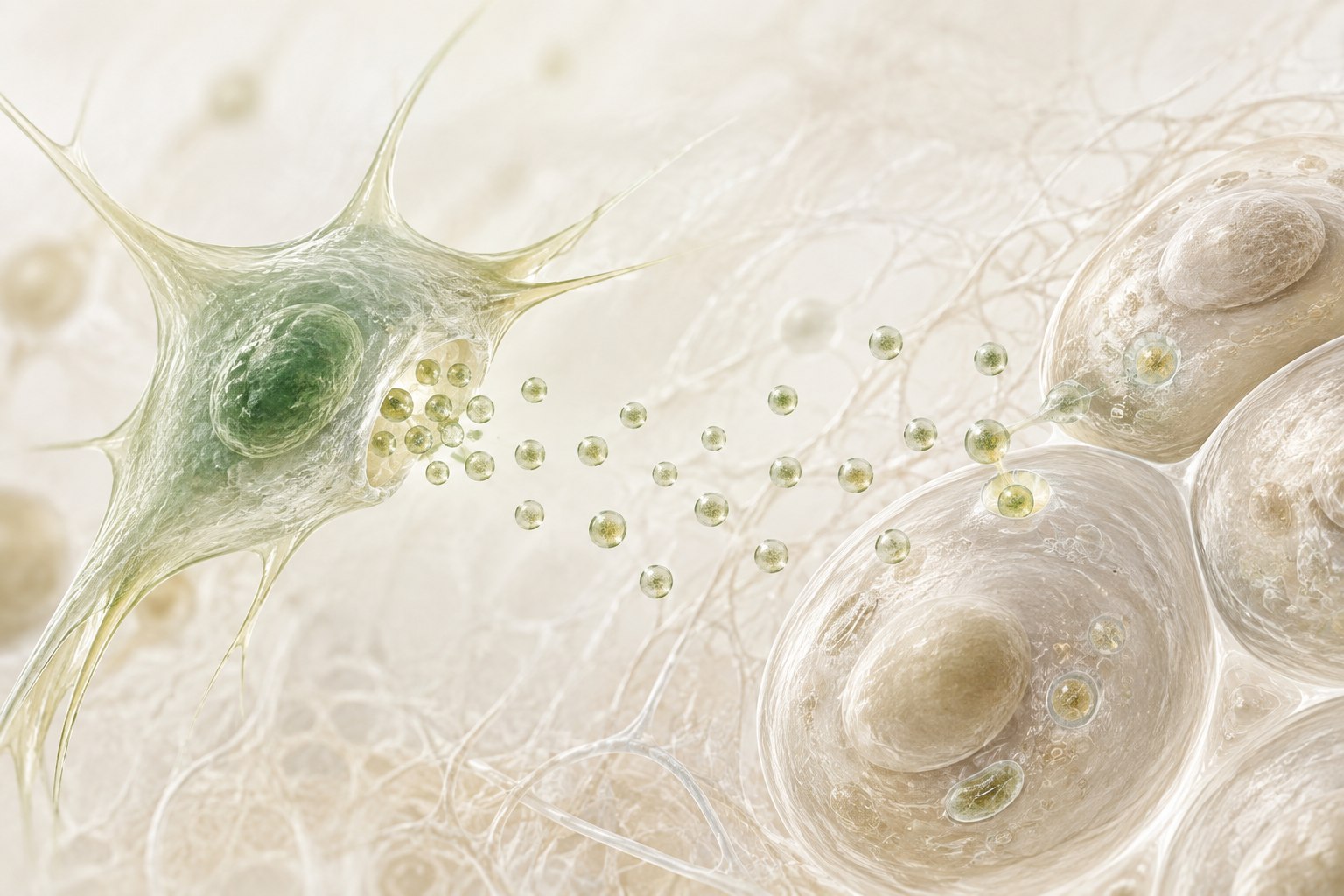
- 01 / SOURCE
Living source cells
Mesenchymal stromal cells are living cells. Their behavior depends on source, handling, dose, and biological context.
- 02 / SIGNAL
Released signals
Cells release soluble factors and extracellular vesicles. Exosomes are one subset of these small vesicles.
- 03 / RESPONSE
Local cell response
Nearby cells may respond to those signals. That biological rationale is where treatment planning starts, not a promise of a result.
What mesenchymal stromal cells are studied to do
MSCs communicate, and that is what makes them interesting. They release cytokines, the proteins cells use to talk to the immune system, along with growth factors and small membrane-bound particles that influence the cells immediately around them. This short-range conversation is called paracrine signalling, and it is why this cell type sits at the centre of regenerative medicine research. Wharton's jelly MSCs are studied particularly for it, because they are strong secretors.
The most studied property is immunomodulation: shifting how an overactive immune and inflammatory response behaves, rather than suppressing it. Alongside this, researchers investigate the effect of released growth factors on the tissue environment, angiogenic signalling relating to the small blood vessels that supply a tissue, and interaction with the extracellular matrix that holds tissue together. In neurological research, the same kind of released factors are studied as neurotrophic signalling, meaning support for nerve cells.
These are the therapeutic goals a plan is built around, and they are a biological rationale rather than a forecast. Laboratory findings about signalling explain why these cells are studied; they do not predict how one person will respond.
- Release cytokines and growth factors that influence nearby cells, known as paracrine signalling
- Help influence how the immune system and inflammatory response behave, known as immunomodulation
- Act on inflammatory pathways that keep a long-term condition active
- Support the local repair processes tissue already runs for itself, including signals relating to small blood vessels and the extracellular matrix
Route, schedule and what follows
Route matters because it decides where the cells are delivered and what the day involves. Our medical team selects it from the goal in your plan, explains what it means in practice, and describes the monitoring that goes with it.
Regenerative medicine treatments are planned individually. Responses vary and no clinical outcome can be guaranteed. Suitability is confirmed only after medical review, and treatment is planned alongside your existing care.
- The route is chosen from the goal your plan sets: intravenous, image-guided injection, or another route we explain
- We record a baseline before treatment so the review afterwards has something to measure against
- Your plan names what we monitor on the day and what to report once you are home
- Follow-up continues alongside your established care and any rehabilitation already in place

Editorial view of Istanbul. This is not a clinic, medical facility, procedure, or treatment outcome.
The plan is written before you travel
A remote case review settles which cells are used, which route is proposed and what your schedule looks like, so your days in Istanbul are treatment days rather than decision days.
MSC therapy: your questions
What is MSC therapy?
MSC therapy is treatment with mesenchymal stromal cells, a cell type studied for the biological signals it releases to surrounding cells. In our programme the cells come from Wharton's jelly, the gelatinous tissue inside a donated umbilical cord. They are expanded and release-tested in the laboratory, then administered by a physician using the route your plan names.
What is the difference between mesenchymal stem cells and stromal cells?
They are two names for the same family of cells. Stromal is the term most researchers now prefer, because these cells are studied mainly for their signalling and their interaction with surrounding tissue rather than for becoming replacement tissue themselves.
How are MSCs given?
The route follows the goal in your plan. It may be an intravenous infusion, an image-guided injection into a joint or tendon, or another route our medical team explains to you. Each route is described in writing before you agree to it, together with what it involves on the day.
How many treatments will I need?
Your plan sets out the number of administrations proposed for your case and the reasoning behind it. We record a baseline before treatment and review against it afterwards, and any repeat treatment is considered from that review rather than scheduled in advance.
What documentation comes with the cells?
Each batch has a certificate of analysis covering identity testing, sterility and endotoxin results, viable cell count, passage, storage conditions and release criteria, alongside the donor screening and traceability record. Our team goes through it with you before the dose is given.
Keep researching
Continue Exploring
Treatment
Stem Cell Therapy
Learn more→
Treatment
Umbilical Cord MSC Therapy
Learn more→
Treatment
Intravenous Stem Cell Therapy
Learn more→
Treatment
Targeted Injection Therapy
Learn more→
Learn
Stem Cell Overview
Learn more→
Learn
How Stem Cells Work
Learn more→
Learn
Safety and Process
Learn more→
Learn
Umbilical Cord Stem Cells
Learn more→
Exosomes
How Exosomes Work
Learn more→
Exosomes
Stem Cells vs Exosomes
Learn more→

International patient support
Ask our medical team about MSC therapy for your case.
Send your diagnosis, recent imaging and current medication. We will explain whether mesenchymal stromal cells fit your case, which route and schedule we would propose, and what your treatment in Istanbul would involve.
Nothing needs to be booked to begin. Our patient coordination team plans your visit to Istanbul once your treatment plan is agreed.