
Umbilical cord stem cells, and the jelly they come from
Our cells come from Wharton's jelly, the gelatinous tissue inside the umbilical cord. Here is what that tissue is, why we chose it, and what is checked before a dose reaches you.
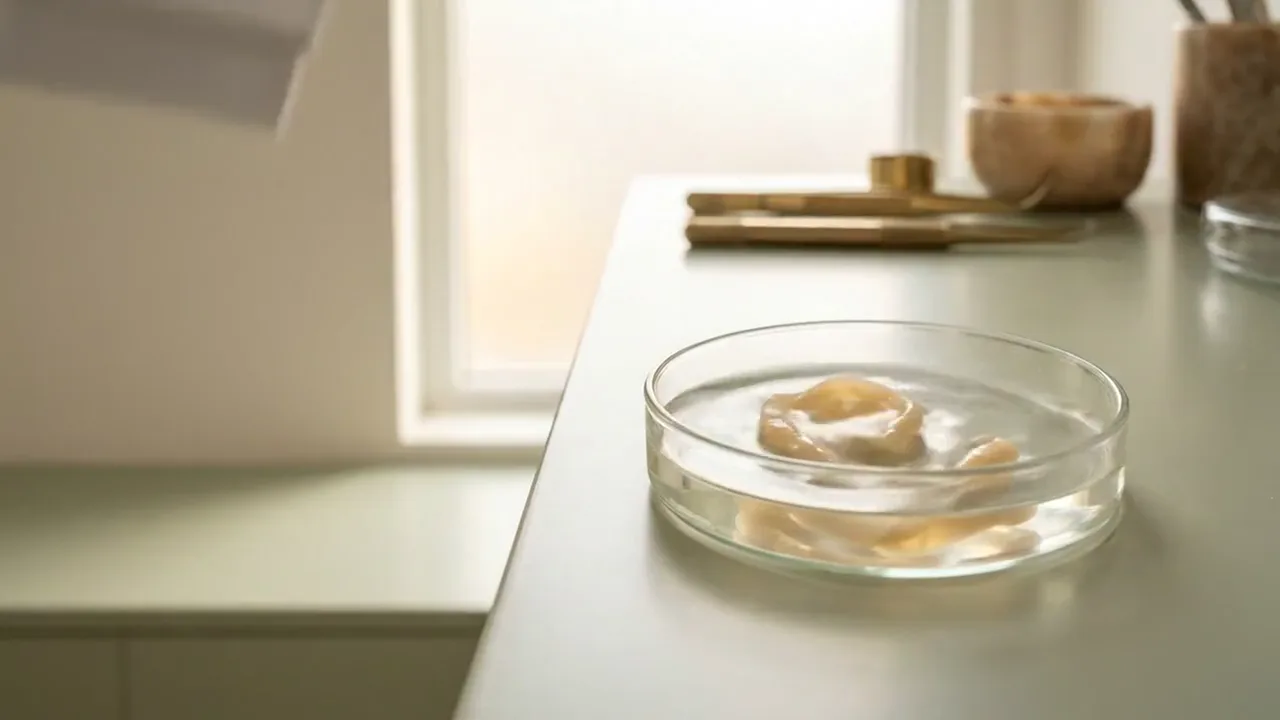
Editorial illustration of laboratory work. It does not depict a procedure or a treatment outcome.
Start here
Wharton's jelly: the tissue inside the cord
Our treatment uses mesenchymal stromal cells from Wharton's jelly, the gelatinous tissue inside the umbilical cord. It is the soft material that surrounds and cushions the cord's blood vessels, and it is an unusually rich source of these cells. When patients search for umbilical cord stem cells, Wharton's jelly is the tissue they are describing.
The cord is donated after a healthy birth, with written maternal consent and after eligibility and infectious-disease screening. It is tissue that would otherwise be discarded, nothing is done to mother or baby to obtain it, and none of the ethical questions attached to embryonic sources arise.
Cord tissue and cord blood are different things. Cord blood is the blood left in the cord and placenta and contains mainly blood-forming cells. Cord tissue is the cord itself, and Wharton's jelly is the tissue inside it: that jelly is where the MSCs in a UC-MSC treatment come from.
Why we use Wharton's jelly stem cells
These are documented properties of the cell type, and together they are the reason this source was chosen rather than an adult one. The age of the tissue matters: Wharton's jelly is perinatal, collected at the very start of a life, whereas bone marrow and fat come from an adult who has carried them for decades.
The practical consequences are just as useful. Because these cells expand readily in culture, a batch can be grown to the size a dose requires and then characterised and release-tested as a whole before anything is administered. And because the cell type carries a low-immunogenicity profile, it is the source studied for use between unrelated people, which is what makes a prepared, tested, documented batch possible at all.
The last point is the one most connected to why these cells are studied. A strong secretory profile means they release a great deal of signalling material, and the signals cells release are the mechanism most mesenchymal stromal cell research now centres on.
- A young perinatal tissue, rather than cells taken from an adult donor or from your own bone marrow or fat
- Collected after a healthy birth from tissue that would otherwise be discarded, with written maternal consent and no harm to mother or baby
- Expands readily in culture, so a whole batch can be characterised and release-tested before any of it reaches a patient
- A low-immunogenicity profile, which is why this source is studied for use between unrelated people rather than requiring your own cells
- A strong secretory profile: these cells are studied for the signalling molecules they release
From donation to dose
What happens between the donation and your treatment
This is where the culture behaviour of these cells becomes practical rather than theoretical. Because they expand readily, a batch can be grown to a consistent viable cell count and then tested as a whole, so what reaches your treatment day is a characterised, release-tested batch with a record attached to it.
A mother consents in writing to donate the cord after a healthy birth, and is screened for infectious disease
The cord is collected, transported under controlled conditions and accepted into the laboratory
The mesenchymal stromal cells are isolated from the Wharton's jelly and expanded to the number a dose requires, with passage and storage conditions recorded
The batch is release-tested for identity, sterility, endotoxin and viable cell count, and gathered into a certificate of analysis
Sourcing and handling
Wharton’s jelly: where our cells come from, and why.
We work with mesenchymal stromal cells from Wharton’s jelly, the gelatinous tissue inside the umbilical cord. It is collected after a healthy birth, with written maternal consent, from tissue that would otherwise be discarded. No harm comes to mother or baby, and none of the ethical questions attached to embryonic sources apply here.
It is also a young, perinatal source rather than adult bone marrow or fat, and it has a low-immunogenicity profile — which is why these cells are studied for use between unrelated people rather than requiring a patient’s own. They expand readily in culture, so a batch can be fully characterised and release-tested before any of it reaches a patient, and they are studied above all for what they secrete: the signalling molecules at the centre of most current MSC research. Before treatment begins, our team takes you through the origin of the material in your plan, how it was handled and what was checked.
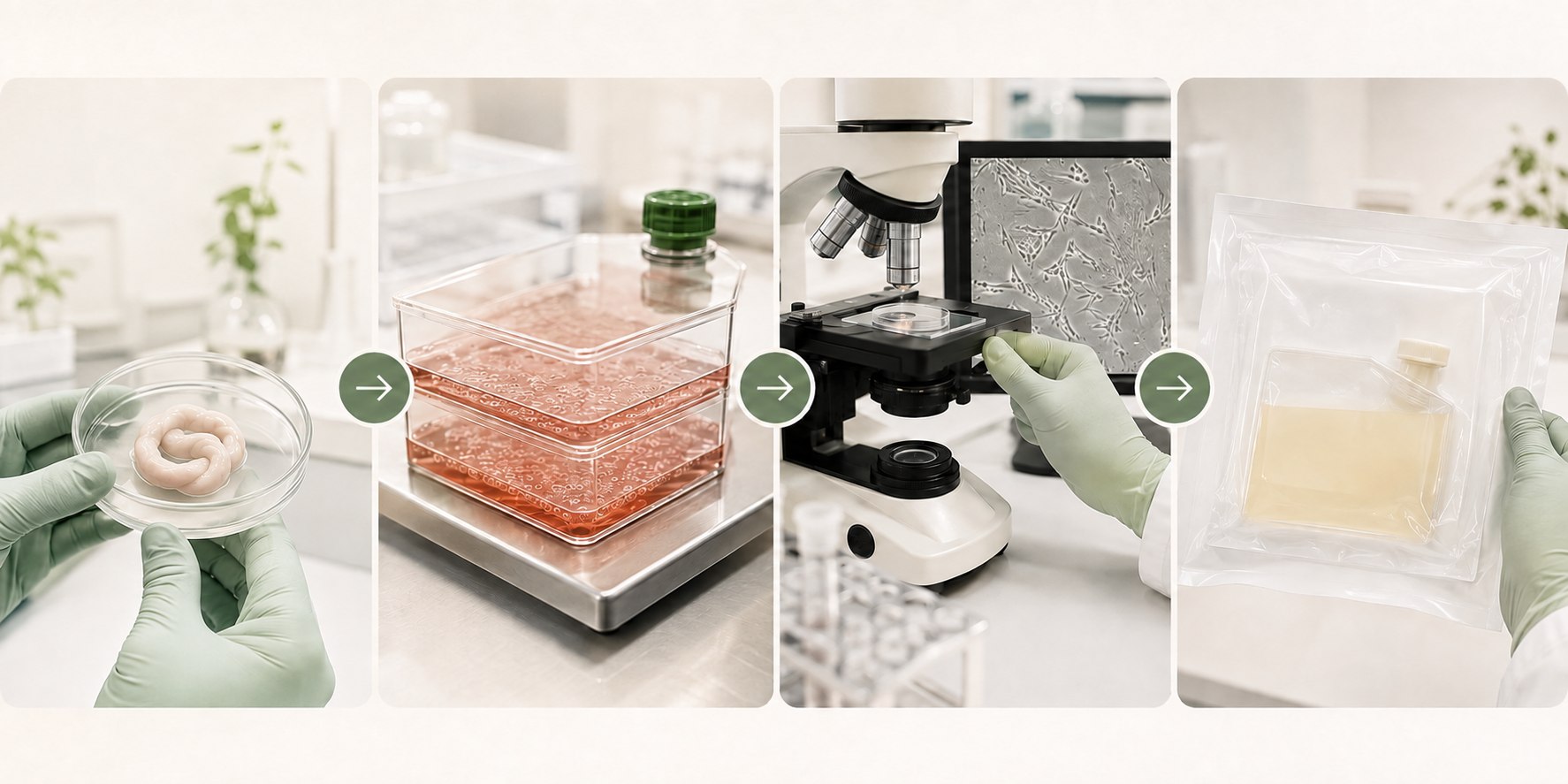
01 / ORIGIN
Donation and consent
The cord is donated after a healthy birth, with written maternal consent and documented donor screening.
02 / ISOLATION
Controlled processing
The cells are isolated from the tissue and expanded in culture, and our team explains where that work is done.
03 / VERIFICATION
Release testing
Identity, sterility, viability and contamination checks are recorded, and the results follow the batch.
04 / CUSTODY
Clinical handling
Storage, transport, preparation and traceability are documented for the material used in your plan.
What donor-derived cells mean for you
These cells come from a donor rather than from you, which is called allogeneic, or donor-derived, use. The low-immunogenicity profile of this cell type is why routine tissue matching is not generally used for donor-derived MSC products, and why the source can be studied so widely between unrelated people. It does not make the cells invisible to your immune system, so our medical team goes through what donor-derived use means for your case before treatment is agreed.
Possible effects depend on the route and the individual, and include infusion or injection reactions, temporary fever or fatigue, and procedure-related risks such as infection at the site. Those are written into your plan alongside the monitoring that goes with them.
- Donor consent, eligibility and infectious-disease screening are documented for every batch
- Chain of custody and de-identification are recorded, and you can ask to see that part of the record
- The treating physician reviews compatibility, infusion and immune considerations for your case
- Your plan lists the possible effects that apply to you, what we monitor for, and who to contact afterwards
What Wharton's jelly MSCs are studied to do
The strong secretory profile of these cells is the whole point. They release cytokines, the proteins cells use to communicate with the immune system, and research follows what those signals do to an inflammatory response that has stayed switched on. What they are not understood to do is travel to an area of damage and become replacement tissue; the research describes cells that signal, and that is a different and more interesting thing.
Immunomodulation, meaning a shift in how the immune system behaves rather than its suppression, is the most studied property of these cells. Alongside it, researchers investigate growth factors and their support for local repair, angiogenic signalling relating to small blood vessels, and interaction with the extracellular matrix that holds tissue together.
Regenerative medicine treatments are planned individually. Responses vary and no clinical outcome can be guaranteed. Suitability is confirmed only after medical review, and treatment is planned alongside your existing care.
- Release biological signals that influence the cells around them, a process called paracrine signalling
- Help influence how an overactive immune and inflammatory response behaves, known as immunomodulation
- Release growth factors studied for the support they may give to the repair processes tissue already runs
- Encourage signals relating to small blood vessels, called angiogenic signalling, since blood supply shapes how tissue recovers

Editorial view of Istanbul. This is not a clinic, medical facility, procedure, or treatment outcome.
Records first, then the journey
Send your diagnosis and recent reports and our medical team reviews them from here. Your visit to Istanbul is arranged once the plan, the route and the schedule are agreed.
Umbilical cord and Wharton's jelly: your questions
What is Wharton's jelly?
The gelatinous connective tissue inside the umbilical cord, the soft material that surrounds and cushions the cord's blood vessels. It is an unusually rich source of mesenchymal stromal cells, which is why our laboratory isolates them from it. Wharton's jelly is the precise name for what is often described more loosely as umbilical cord tissue.
What are umbilical cord stem cells?
Mesenchymal stromal cells isolated from Wharton's jelly inside a cord donated after a healthy birth. The cord would otherwise be discarded, the mother consents in writing, and she is screened for infectious disease before anything is used. Nothing is done to mother or baby to obtain the tissue.
Why does our clinic use Wharton's jelly as the source?
Because it is a young perinatal tissue rather than an adult one, it is collected without any procedure on a patient, the cells expand readily in culture so a whole batch can be characterised and release-tested in advance, and the cell type carries a low-immunogenicity profile and a strong secretory profile. Those are documented properties of the cell type, and together they are a good reason to choose this source.
Are Wharton's jelly stem cells the same as embryonic stem cells?
No, and the two are not related. These cells come from a cord collected after a birth has already taken place, with written maternal consent, from tissue that would otherwise be thrown away. None of the ethical questions attached to embryonic sources arise here, and the donation and collection process is documented for every batch.
Is cord tissue the same as cord blood?
No. Cord blood is the blood left in the cord and placenta after birth, and it contains mainly blood-forming cells. Cord tissue is the cord itself, and Wharton's jelly is the tissue inside it. That jelly is the starting material for the mesenchymal stromal cells used in our programme.
Why use donated cells rather than my own?
Harvesting your own cells means a procedure on you, and adult bone marrow or fat is an older starting material. A Wharton jelly MSC batch is grown, characterised and release-tested to a consistent viable cell count before a dose is prepared, and the low-immunogenicity profile of these cells is why this source is studied for use between unrelated people.
Do I need to be a tissue match?
Routine tissue matching is not generally used for donor-derived MSC products, and the low-immunogenicity profile of this cell type is a large part of why. That does not make the cells invisible to your immune system, so the treating physician reviews compatibility, infusion and immune considerations for your case.
What quality documentation comes with my batch?
A certificate of analysis covering identity testing, sterility and endotoxin results, viable cell count, passage, storage conditions and release criteria, alongside the donor screening and traceability record. Our team goes through it with you before the dose is given.
Keep researching
Continue Exploring
Treatment
Umbilical Cord MSC Therapy
Learn more→
Treatment
Stem Cell Therapy
Learn more→
Treatment
Intravenous Stem Cell Therapy
Learn more→
Learn
Stem Cell Overview
Learn more→
Learn
MSC Therapy
Learn more→
Learn
How Stem Cells Work
Learn more→
Learn
Safety and Process
Learn more→
Exosomes
How Exosomes Work
Learn more→
Exosomes
Stem Cells vs Exosomes
Learn more→

International patient support
See whether Wharton's jelly MSCs suit your case.
Send your diagnosis, recent imaging and current medication. Our medical team reviews your records and explains whether a Wharton's jelly MSC treatment may fit your case, what the goals would be, and how your visit to Istanbul would be planned.
Nothing needs to be booked to begin. Our patient coordination team plans your visit to Istanbul once your treatment plan is agreed.