
Stem Cell Therapy After Lyme Disease in Istanbul, Turkey
How our medical team assesses ongoing fatigue and pain after treated Lyme disease, what a plan may involve, and how to start a records review.

Understanding Lyme Disease
Lyme disease is an infection caused by Borrelia bacteria carried by ticks, and antibiotics clear the infection in most people. For a minority, fatigue, aching joints and muscles, cognitive fog, disturbed sleep and low stamina persist for months afterwards - a pattern doctors call post-treatment Lyme disease syndrome, and patients more often call chronic Lyme disease. The symptoms are real and often disabling, even where tests no longer show active infection.
What a supportive plan is aimed at in this group is immune and inflammatory activity that has not settled back to baseline - not the bacteria, which antibiotics have usually already dealt with. Mesenchymal stromal cells are studied for their influence on immune behaviour, known as immunomodulation, and for the signals they release into surrounding tissue. Our program works with MSCs from Wharton's jelly, the gelatinous tissue inside a donated umbilical cord, a young perinatal source characterised and release-tested before use. One thing has to be exact: this is not an antimicrobial treatment and does not clear an infection, and our team will say so plainly.
Because persistent symptoms after an infection have several possible explanations, our medical team reviews the original diagnosis and how it was confirmed, the antibiotic courses given, and then looks deliberately for other contributors - thyroid and iron status, sleep disorder, autoimmune disease, mood, deconditioning and medication effects. Several of those are treatable in their own right. Where a supportive plan is appropriate, the aim may focus on fatigue, pain burden and daily capacity, tracked with symptom scores agreed at the start. Send your diagnostic history and recent bloods, and ask our medical team what it would rule out first.
How Lyme Disease Can Affect Daily Life
Symptoms, severity and progression vary from person to person. Our medical team uses this kind of detail as context for your case review; it is not a diagnostic checklist. Diagnosis, and any change in your symptoms, belong with the clinician who knows your medical history.
- Persistent fatigue
- Brain fog
- Joint pain
- Sleep problems
- Reduced stamina and recovery
Timing and objective findings matter in Lyme disease
Lyme disease has early and later presentations, and persistent symptoms can have several explanations. The visual keeps the timeline, the findings, and the alternatives side by side.
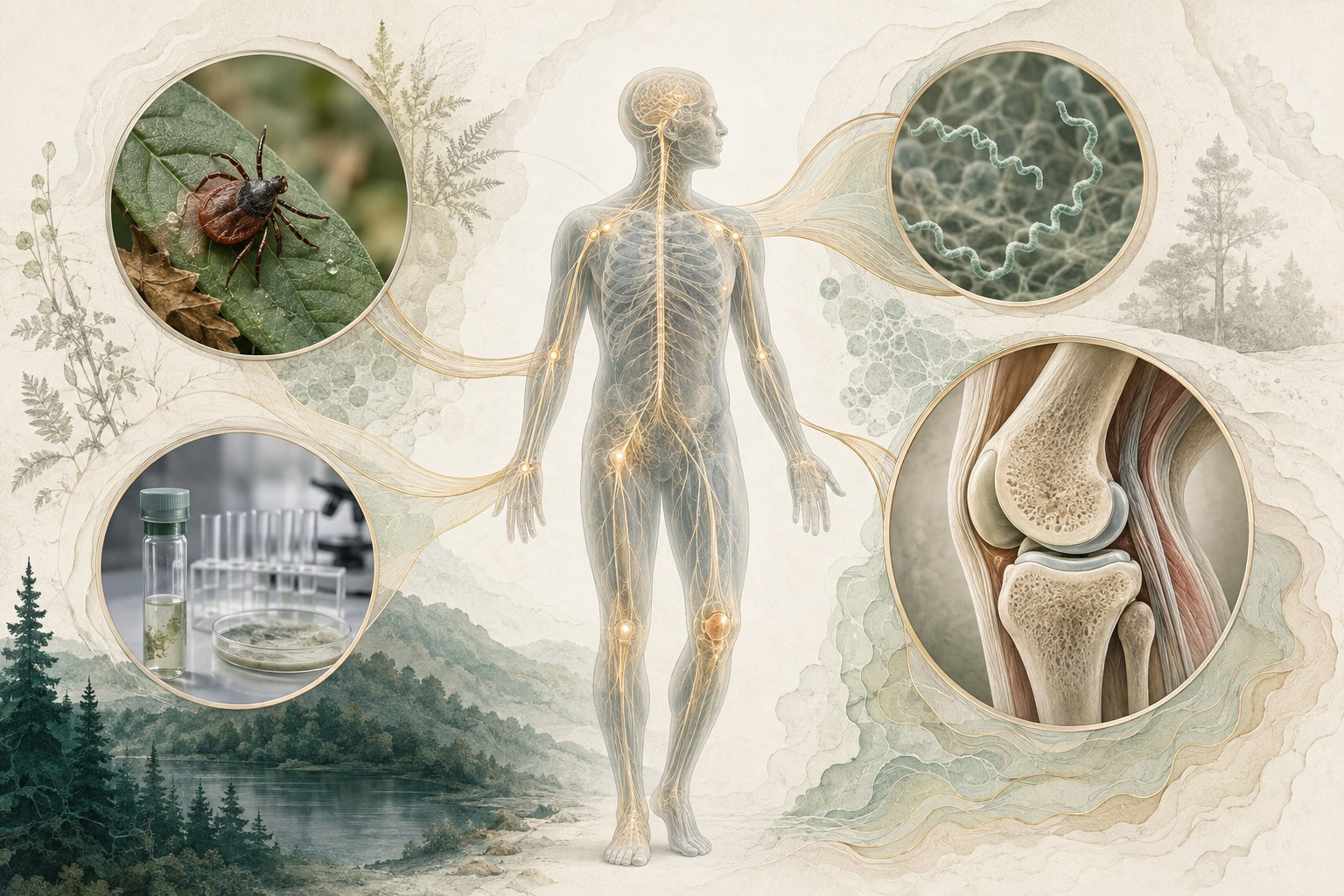
Clinical context

Microscopic research viewIllustrative detail
- Exposure and timing
- Geography, tick exposure, rash, symptom onset, and previous antibiotics establish the clinical sequence.
- Possible manifestations
- Skin, nervous system, joints, and heart can each be involved, with established evaluation and treatment pathways.
- Persistent symptoms
- Fatigue, pain, or cognitive concerns deserve a careful look for overlapping and treatable causes as well.
Why Regenerative Medicine Is Being Studied in Lyme Disease
These are the biological mechanisms researchers are investigating. A mechanism is a reason to study a treatment, not a promise of benefit for an individual patient. Our medical team will explain how much of this research applies to your own diagnosis.
- MSCs are studied for their influence on immune and inflammatory behaviour, known as immunomodulation
- They release signals into surrounding tissue, a process called paracrine signalling
- This is not an antimicrobial treatment: it does not clear a Borrelia infection and is not presented as doing so
- Other treatable causes of persistent fatigue and pain are looked for first, because several respond to specific treatment
- Symptom scores are agreed before treatment so any change can be tracked rather than recalled
- The aim may focus on fatigue, pain burden and daily capacity, defined with you at the start
Research maturity
What the Research Currently Shows for Lyme Disease
How far published research has travelled for each approach, from laboratory work through to established standard care. It describes the maturity of the evidence, not how well any option works and not what to expect in an individual case.
- 01Laboratory and animal work
- 02Early human studies
- 03Controlled trials under way
- 04Established standard of care
Guideline-recommended antibiotic therapy and symptom-directed rehabilitation
Standard infectious-disease treatment to eradicate Borrelia infection, followed by multidisciplinary supportive care for post-treatment symptoms.
Established standard of care
Systemic cell or exosome therapy for post-treatment Lyme syndrome
Explored only as an investigational immune-modulating hypothesis after antimicrobial eradication; no controlled human trials exist.
Laboratory and animal work
Your case review
How Our Medical Team Reviews Your Case
Your review starts with the confirmed diagnosis, recent reports and imaging, current treatment, medical history, and the outcome that matters most to you. Not everyone is suitable for regenerative medicine, and our team will say so when the care you already receive is the better route.
- A documented Lyme diagnosis with the testing that confirmed it and the antibiotic treatment given
- A current symptom picture: what is worst, how a week looks, and what makes it fluctuate
- Screening for other contributors - thyroid, iron, autoimmune markers, sleep and mood
- A full medication and supplement list for our medical team to review
- Realistic goals around energy, pain and daily capacity, written into the plan
- Medical fitness for travel, confirmed before an Istanbul visit is arranged
How Treatment for Lyme Disease Is Planned at Our Istanbul Clinic
The path international patients follow with us, from the first review of your records to follow-up after you return home. The exact steps depend on what your medical review finds.
Send your medical records
Recent reports, imaging, your current medication, and what you hope treatment will help with. It lets our medical team make the review specific to you.
Start your case reviewSend your medical records
Your case review starts with the confirmed diagnosis, recent reports and imaging, current medications, previous procedures and the outcomes that matter most to you. Everything can be sent digitally from home, long before travel is discussed.
Case review by our medical team
Our medical team reads the file against your diagnosis, disease stage, imaging, laboratory results, current treatment and any contraindications, then decides whether regenerative medicine is appropriate for you and which goals are realistic to discuss.
Your written treatment plan
When treatment is appropriate, you receive the plan in writing: the cell material and how it is prepared, the dose, the route of administration, the number of sessions, the monitoring involved and an itemized cost with no assumed extras.
Your treatment in Istanbul
On arrival our team repeats the checks that matter for your case, confirms the plan with you, and carries out treatment under medical supervision with an observation period afterwards. Your coordinator handles scheduling, timings and what each day involves.
Follow-up and monitoring
Before you fly home we agree what will be measured, when it will be reviewed and how to reach us. Follow-up continues remotely and can be shared with your own doctors, so your treatment plan and your local care stay aligned.
Your treatment plan
What Our Medical Team Explains Before You Decide
"Stem cells" and "exosomes" name a category, not a specific product. What matters in your plan is the source of the material, how it was prepared, the route and the dose, the clinical setting, and why you were considered suitable. Our medical team sets each of those out for the treatment being proposed to you.
We plan treatment alongside the care you already receive, so keep your own clinician involved and record a clear baseline before you travel. For the practical side, read the Istanbul treatment trip guide and the cost guide, then ask us for an itemized estimate.
- Which published research applies to your diagnosis and to the route we propose.
- Where the biological material comes from, how it is prepared, and how it is documented.
- The possible side effects and the contraindications that apply to your procedure.
- Which functional outcome is measured before treatment and again at follow-up.
- How treatment sits alongside your existing care, including the option of not treating.
- Who to contact about follow-up, or about a complication, once you are home.
- What your estimate includes and excludes, and what is due before you travel.
Next step
Start with a medical case review
Send your diagnosis, recent reports, imaging and current medication, and tell us what you want treatment to help with.
Lyme Disease: Questions Patients Ask Us
What do cell procedures after Lyme disease cost in Istanbul, Turkey?
Laboratory work, the number of infusions and the length of monitored stay are the main items, and our patient coordination team quotes testing and treatment as two separate things. If a test is offered to you elsewhere that our medical team would not act on, we will tell you that before you pay for it.
Does treatment clear a persistent infection?
No, and that claim is worth treating with suspicion wherever you meet it. What our medical team can discuss is a supportive plan aimed at symptom burden, alongside a proper search for other causes of the fatigue and pain you are living with.
Are Wharton's jelly stem cells used to treat Lyme Disease in Istanbul?
Yes. Our regenerative medicine program works with mesenchymal stromal cells (MSCs) grown from Wharton's jelly, the gelatinous tissue inside the umbilical cord. It is donated after a healthy birth with written maternal consent, from tissue that would otherwise be discarded, so nothing is taken from mother or baby and none of the ethical questions attached to embryonic sources arise. Because these cells expand readily in culture, a batch is characterised and release-tested before it reaches anyone. Your written plan names the material, how it is prepared, the dose, the route of administration and the schedule, and our medical team explains why each of those was chosen for your case.
Why use donor cells from Wharton's jelly rather than my own cells for Lyme Disease?
Wharton's jelly is a young, perinatal tissue rather than an adult one, so the starting material does not carry the age or the health history of the person being treated, and nothing has to be harvested from you on the day. These cells also have a low-immunogenicity profile, which is why this source is studied for use between unrelated people. Most of all, they are strong secretors: the signalling molecules MSCs release are the mechanism most current research centres on, and that is what a plan is built around.
How long do international patients stay in Istanbul for Lyme Disease treatment?
The length of stay follows your plan: the route of administration, the number of sessions, the monitoring after each one, and any mobility or assistance you need. Our patient coordination team confirms appointment dates, daily timings and the expected length of the visit in writing before you book flights.
Is stem cell therapy for Lyme Disease safe?
No medical procedure is free of risk. Our medical team screens for infection, bleeding risk, medication interactions and other contraindications before treatment, explains the risks specific to the route used in your plan, and monitors you during administration and afterwards. If something makes treatment unsafe for you, we say so instead of proceeding.
What can stem cell therapy realistically aim for in Lyme Disease?
Goals are set with you and described as aims, not results. Regenerative medicine treatments are planned individually, responses vary between patients and no clinical outcome can be guaranteed. Your plan states what will be measured, when it will be reviewed, and how treatment sits alongside the care you already receive.
How do I start a Lyme Disease case review from outside Turkey?
Send your confirmed diagnosis, recent reports and imaging, your current medication list, previous procedures and the goals that matter to you. Our medical team reviews them remotely and comes back with an assessment of whether treatment in Istanbul is appropriate for your case, and what the next step would be.
Medical Disclaimer: Information on this page is educational and is not personal medical advice. Regenerative medicine treatments are planned individually, responses vary and no clinical outcome can be guaranteed. Some of the approaches described remain investigational. Suitability is confirmed only after medical review, and treatment is planned alongside your existing care.

Sunrise from Istanbul's Asian shore, looking across the water. It shows the city you would travel to, not our clinic, your accommodation, or a service included in a plan.
Let the Lyme Disease case review lead the itinerary
We confirm the diagnosis, the relevant records, medication, accessibility, costs, appointment timing, and follow-up before an Istanbul trip is booked for Lyme Disease.
Keep researching
Treatments and Related Conditions for Lyme Disease
Treatment
Intravenous Stem Cell Therapy
How an infusion session runs, how you are monitored, and when our team proposes this route.
Learn more→
Treatment
Umbilical Cord MSC Therapy
The cord-tissue mesenchymal cells we work with, from donor screening to batch release testing.
Learn more→
Treatment
Exosome Therapy
Vesicle-based preparations, how they differ from a cell therapy, and where the research currently stands.
Learn more→
Condition
Fibromyalgia
How regenerative medicine is planned for Fibromyalgia at our Istanbul clinic.
Learn more→
Condition
Long COVID
How regenerative medicine is planned for Long COVID at our Istanbul clinic.
Learn more→
Condition
Lupus (Systemic Lupus Erythematosus)
How regenerative medicine is planned for Lupus (Systemic Lupus Erythematosus) at our Istanbul clinic.
Learn more→
Condition
Rheumatoid Arthritis
How regenerative medicine is planned for Rheumatoid Arthritis at our Istanbul clinic.
Learn more→
Condition
Neuropathy
How regenerative medicine is planned for Neuropathy at our Istanbul clinic.
Learn more→
More from our clinic
Planning treatment for Lyme Disease in Istanbul
The practical side of treatment at our clinic: what the research shows, who may be suitable, what a plan costs, and how your stay in Istanbul and your follow-up are arranged.
Cost, Outcomes & Istanbul
- Visit our Istanbul clinicWhere we are, how patients reach us, and what to arrange before you travel.
- Understand treatment pricingWhat shapes a quote, and what an itemized estimate from our clinic covers.
- Planning your Istanbul treatment tripRecords, travel timing, local transport, accommodation, and follow-up after you fly home.
- Choosing a stem cell clinic in IstanbulHow we document candidacy, pricing, clinical oversight, and aftercare for international patients.
- Rules and oversight in TurkeyHow regenerative medicine is regulated in Türkiye, and the paperwork that accompanies treatment.
- Reading stem cell success ratesWhat a published percentage can and cannot tell you about your own diagnosis.
- What your treatment quote includesWhat the clinical fee covers, which items are listed separately, and what moves the total.
- What to expect during treatmentThe remote case review, your written plan, the treatment day, and follow-up once you are home.
- Longevity and healthy-ageing care in IstanbulWhat our longevity programme assesses, and how it differs from treating a diagnosed condition.
- What exosome treatment in Istanbul costsHow we structure an exosome quote, and the line items a written estimate names.
- Exosome therapy questions we are askedSourcing, dosing, regulation, and the documentation that accompanies a proposed treatment.
- Medical travel to Turkey: patient guideHow remote record reviews, clinic scheduling, and travel logistics fit together.
- Comparing treatment abroad: Turkey vs MexicoQuestions to ask when comparing clinics, cell documentation, and oversight across countries.
Condition guides
Treatments & the science
- Stem Cell Therapy Overview
- Introduction to Stem Cell Therapy
- Umbilical Cord Stem Cells (UC-MSCs)
- Mesenchymal Stem Cell (MSC) Therapy
- How Stem Cells Work
- Safety & Treatment Process
- Exosome Therapy Overview
- How Exosomes Work
- Stem Cells vs Exosomes
- Intravenous (IV) Stem Cell Therapy
- Intrathecal Stem Cell Therapy
- Longevity Program
- See all treatments →

International patient support
Ask our medical team about treatment for Lyme Disease.
Send your diagnosis, recent reports, imaging and current medication. Our medical team reviews them and explains which regenerative medicine options may fit your case, and what treatment in Istanbul would involve.
Nothing needs to be booked to begin. Our patient coordination team plans your visit to Istanbul once your treatment plan is agreed.