
Stem Cell Therapy Explained for International Patients
What the cells are, what treatment aims to influence, how the delivery route is chosen, and how our medical team turns a diagnosis into a plan.

Editorial explainer. It does not show an individual patient result.
What Stem Cell Therapy Means in Our Clinic
Stem cell therapy is a category of treatments rather than one standard procedure. In our regenerative medicine programme it means a preparation of living cells, given by a route chosen for your case, alongside the care you already receive.
The cells we work with most are mesenchymal stromal cells, usually shortened to MSCs, including cells taken from donated umbilical cord tissue. They are still widely called mesenchymal stem cells; the stromal name is now preferred, because in the body these cells have not been shown to behave as true stem cells. What they are studied for is something else, and it is the subject of the next section. Our umbilical cord MSC therapy guide describes that material in more detail.
Stem cells and exosomes are different.
One is a living cell. The other is a cell-derived messenger. The difference shapes how each is sourced, how it is given, and which one our medical team may propose for your case.
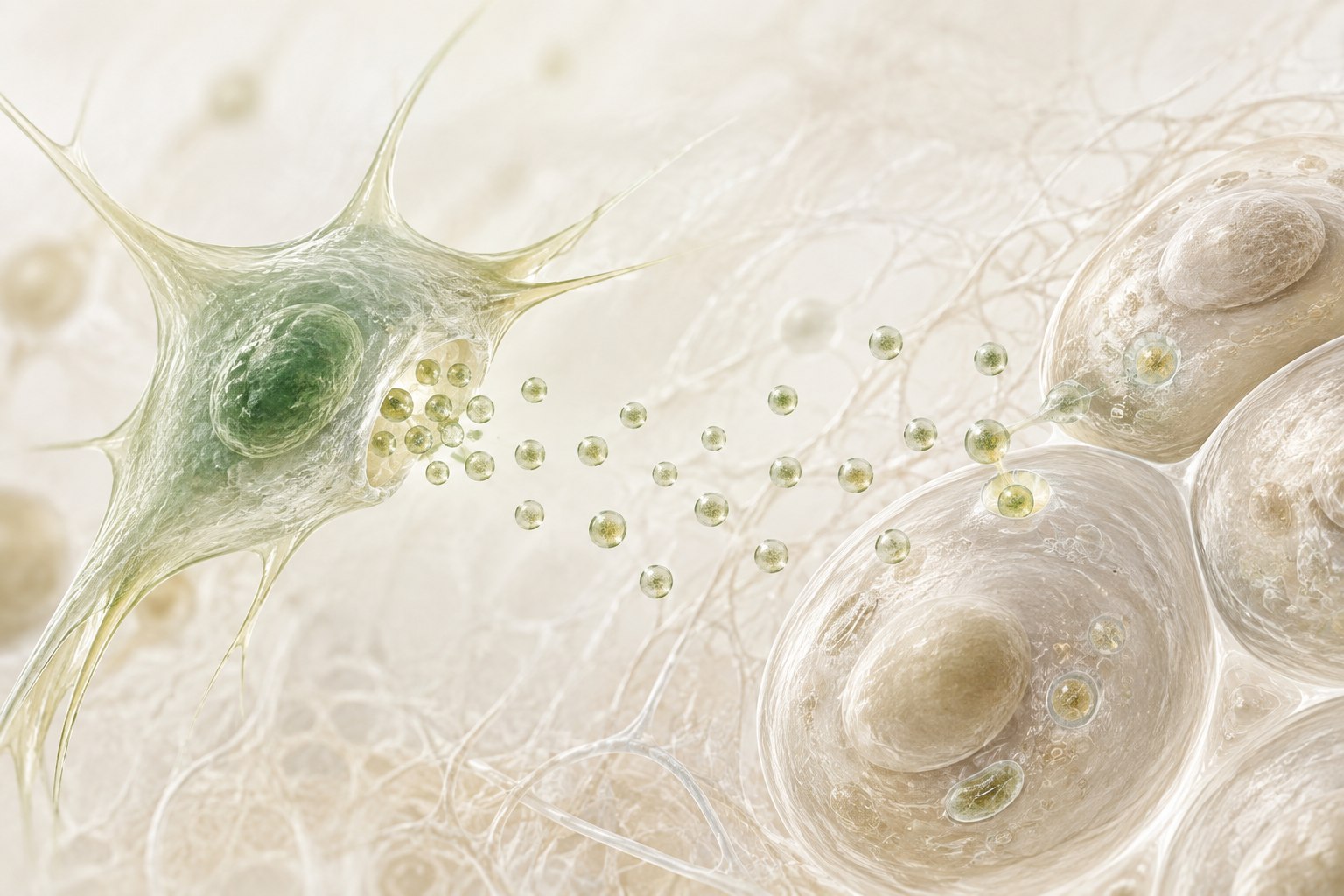
- 01 / SOURCE
Living source cells
Mesenchymal stromal cells are living cells. Their behavior depends on source, handling, dose, and biological context.
- 02 / SIGNAL
Released signals
Cells release soluble factors and extracellular vesicles. Exosomes are one subset of these small vesicles.
- 03 / RESPONSE
Local cell response
Nearby cells may respond to those signals. That biological rationale is where treatment planning starts, not a promise of a result.
How Mesenchymal Stromal Cells Are Thought to Work
Cells talk to the cells around them. They release soluble factors and tiny particles that carry biological messages, and neighbouring cells respond to those messages. Researchers call this paracrine signalling, and the particles extracellular vesicles. It is the main reason MSCs are studied in regenerative medicine.
Two lines of that research come up most often in the conditions we are asked about. The first is how these signals may influence the way the immune system and the inflammatory response behave, known as immunomodulation. The second is how they may interact with the tissue environment around an injury, including the signals that support local repair and blood supply.
This is a description of what treatment aims to influence, not a promise of what it will achieve. For most of the conditions patients ask us about, cell therapy is still being investigated rather than settled, and responses differ between people. We plan around that honestly: goals first, measured afterwards. The science guide to how stem cells work goes a step further into the biology, and stem cells compared with exosomes explains where cell-free products differ.
What Defines Your Treatment Plan
A treatment name on its own says very little. These five details are what make one plan different from another, and our medical team sets each of them against your diagnosis, your imaging and laboratory results, the medicines you take and the goals you want to work towards. You receive them in writing before anything is booked.
- The cell material proposed for you and the tissue it came from
- How that material is documented from donation to the day it is used
- The preparation, dose and schedule, and the reasoning behind them
- The delivery route, the setting, and who performs the procedure
- The measures we follow afterwards and who you contact with questions
How the Delivery Route Is Chosen
Intravenous infusion
Cells enter the bloodstream and circulate. Used where the therapeutic goal is systemic rather than confined to one joint or site.
Image-guided injection
Cells are placed at a defined target, such as a joint or tendon, with imaging used to confirm the position.
Intranasal delivery
A needle-free route applied to the nasal lining, considered in some neurological plans and discussed case by case.
Intrathecal administration
Delivery into the fluid around the spinal cord through a lumbar puncture, a procedure with its own consent and monitoring.
A more invasive route is not a stronger treatment. Each one reaches different tissue and carries its own procedural considerations, so the route follows the target and your safety. Your plan names the route, the setting, the clinician responsible, the monitoring during and after the procedure, and what we do if a complication occurs.
Who We Can Consider, and How We Assess It
Suitability is decided by review, not by a condition appearing on a website. Our medical team looks for a confirmed diagnosis supported by recent records, a clear picture of the treatment you already receive, and goals that can be followed over time. We also assess contraindications, medication interactions and whether you are well enough for both the procedure and international travel.
Some findings mean we do not proceed, including active infection, a relevant cancer history, pregnancy and certain immune conditions, until a clinician has assessed them. If the review shows that treatment is not appropriate for your case, we tell you that rather than offering a plan anyway. Our safety and process guide sets out how material is handled and what is checked before use.
What Research Currently Supports
Some cell therapies are long-established: blood-forming stem cell transplantation is routine care for selected blood disorders. Much of the work with mesenchymal stromal cells is younger, and the strength of the evidence differs by condition, by product and by delivery route. We would rather you hear that from us than discover it later.
Regenerative medicine treatments are planned individually. Responses vary and no clinical outcome can be guaranteed. Suitability is confirmed only after medical review, and treatment is planned alongside your existing care, not in place of it. Nothing here asks you to change or stop a treatment your own clinician has prescribed.

Editorial Istanbul scene. It is not a clinic, procedure, or treatment outcome.
From a first question to a written plan
Most patients start with records and a conversation, long before a flight is booked. A clear written plan is what makes the next step feel manageable.
Stem Cell Therapy: Common Questions
Is stem cell therapy one standard procedure?
No. It is a category of treatments rather than a single operation. Established uses such as blood-forming stem cell transplantation for selected blood disorders sit alongside uses that are still being investigated. What makes a plan specific is the cell material, its source, the preparation and dose, the delivery route, the schedule and the follow-up, and our medical team sets those after reviewing your records.
Which cells does our clinic work with?
Our regenerative medicine programme works mainly with mesenchymal stromal cells, usually shortened to MSCs, including cells from umbilical cord tissue. These cells are studied for the biological signals they release and for how they interact with immune and repair processes. Our team will explain which material was selected for your plan and why.
Does a biological rationale mean the treatment will work?
No, and we keep the two separate on purpose. A rationale describes what a treatment aims to influence in the body. Whether that changes symptoms for a particular person is a different question, answered by clinical research and by individual review. We describe therapeutic goals, not guaranteed results.
How is the delivery route chosen?
The route follows the target and your safety, not a scale of strength. An intravenous infusion, an image-guided injection into a joint, intranasal delivery and intrathecal administration reach different tissues and carry different procedural considerations. Your written plan names the route, the setting, who performs it and how you are monitored.
What will my written treatment plan tell me?
The material proposed and its tissue source; how that material is documented from donation through preparation to the day it is used; the dose, route and schedule; the reasoning for your diagnosis and current health; the measures we will follow afterwards; and an itemised cost. It is written for your records, medicines and goals rather than as a general brochure.
What happens during a medical case review?
You send your diagnosis, recent reports and imaging, current medicines and the goals that matter to you. Our medical team reviews them alongside your existing care and replies with what may be appropriate, what it involves in Istanbul, and what it would cost. If treatment is not appropriate for your case, we say so.

International patient support
Send your diagnosis and let our team review it
Share your records, current medicines and the goals that matter to you. Our medical team will tell you whether a plan may be appropriate, what it would involve in Istanbul, and what it would cost.
Nothing needs to be booked to begin. Our patient coordination team plans your visit to Istanbul once your treatment plan is agreed.