
Stem cells and exosomes: what is the difference
One delivers living cells. The other delivers the messages cells send. Here is what each contains, what it is studied to do, and how our medical team chooses.

Editorial illustration of cell biology. It does not depict a procedure or a treatment outcome.
The short answer
One delivers cells, the other delivers messages
Mesenchymal stromal cells are living cells that release biological signals to the cells around them; ours come from Wharton's jelly, the gelatinous tissue inside a donated umbilical cord. Exosomes are some of those signals, collected on their own: tiny particles carrying proteins, lipids, signalling molecules and RNA, with no living cells in the preparation.
That single difference explains most of the others, including how each is prepared, how it is given, and which goals it is usually planned around.
Side by side
The same six questions, asked of both
What it is
What is given?
- MSC treatment
- Living mesenchymal stromal cells, prepared as a dose with a viable cell count
- Exosome preparation
- A cell-free preparation of the tiny vesicles cells release
Where does it come from?
- MSC treatment
- Wharton's jelly, the gelatinous tissue inside an umbilical cord donated after a healthy birth, then isolated and expanded in the laboratory
- Exosome preparation
- Cells in culture, whose released vesicles are collected, concentrated and characterised
What is studied
What is it studied to do?
- MSC treatment
- Paracrine signalling, immunomodulation, growth factors and angiogenic signalling
- Exosome preparation
- Transfer of cargo between cells, inflammatory signalling and support for the tissue environment
Where is it most often used?
- MSC treatment
- Autoimmune and inflammatory conditions, neurological diagnoses, and joint and tendon problems
- Exosome preparation
- Skin quality, thinning hair and the scalp, and joint, tendon and soft-tissue concerns
How it is planned
How is it given?
- MSC treatment
- Intravenous infusion, image-guided injection, or another route your plan names, administered by a physician
- Exosome preparation
- A skin or scalp procedure, a local injection, or an intravenous infusion, administered by a clinician
What documentation comes with it?
- MSC treatment
- A batch certificate of analysis with identity, sterility, endotoxin, viable cell count, passage and storage, plus donor screening and traceability
- Exosome preparation
- The source of the preparation, how it was produced and characterised, its release testing, and its storage and handling
Stem cells and exosomes are different.
One is a living cell. The other is a cell-derived messenger. The difference shapes how each is sourced, how it is given, and which one our medical team may propose for your case.
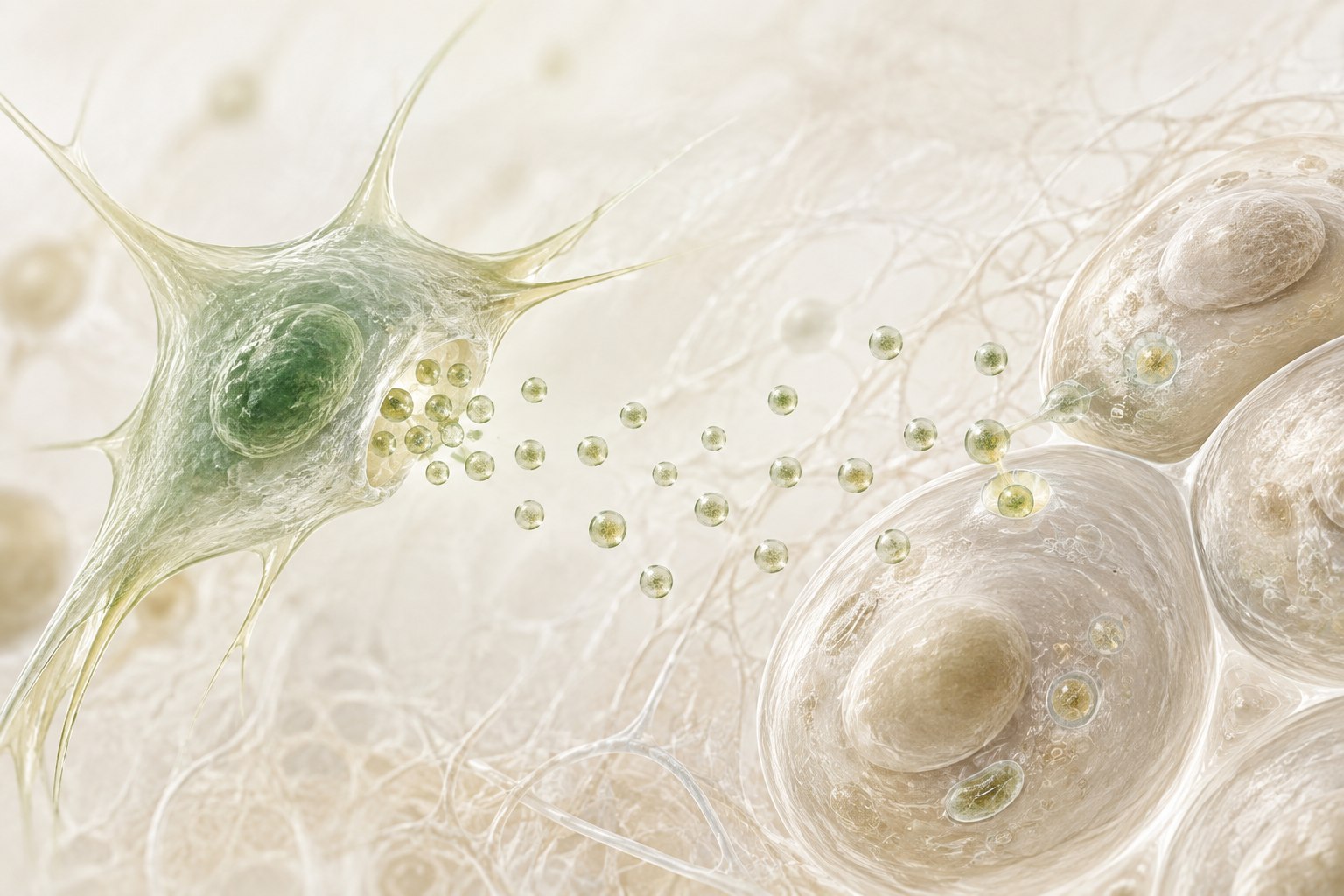
- 01 / SOURCE
Living source cells
Mesenchymal stromal cells are living cells. Their behavior depends on source, handling, dose, and biological context.
- 02 / SIGNAL
Released signals
Cells release soluble factors and extracellular vesicles. Exosomes are one subset of these small vesicles.
- 03 / RESPONSE
Local cell response
Nearby cells may respond to those signals. That biological rationale is where treatment planning starts, not a promise of a result.
How our medical team chooses between them
The choice follows the goal rather than the category. Immunomodulation is the most studied property of Wharton's jelly MSCs, which is why autoimmune, inflammatory and neurological cases usually start there. Skin quality and scalp concerns more often begin with an exosome preparation, and joint and tendon problems are discussed either way depending on what the imaging and examination show.
Some patients also prefer a preparation that contains no living cells, and some cases make a cell product less suitable. Our medical team explains the reasoning either way, in writing, before anything is agreed.
- What you want to improve, described in terms that can be reviewed later
- What your records, examination and imaging show about the target
- Which route reaches that target, and what the day would involve
- Whether a cell-free preparation suits your case better than a cell product
Can the two be used together?
The two are sometimes planned together and sometimes not. Where a combined plan is proposed, our medical team explains what each component is there for and prices them separately, rather than presenting more components as automatically better.
Regenerative medicine treatments are planned individually. Responses vary and no clinical outcome can be guaranteed. Suitability is confirmed only after medical review, and treatment is planned alongside your existing care.
- Each component is explained on its own terms, with its own goal
- Costs are itemised separately, so you can see what each part contributes
- You can take one without the other, and we will say when one alone is the better answer
- Goals and baselines are recorded before treatment so the review afterwards is meaningful

Editorial view of Istanbul. This is not a clinic, medical facility, procedure, or treatment outcome.
A comparison should end in a clear next step
Send your records and tell us what you would like to improve. Our medical team will say which of the two we would propose for your case, and why.
Stem cells and exosomes: your questions
What is the difference between stem cells and exosomes?
A stem cell product contains living mesenchymal stromal cells. An exosome preparation contains the tiny signalling particles cells release, and no cells at all. One delivers cells, the other delivers the messages cells send.
Which one is better?
Neither is better as a category. They suit different goals. Our medical team chooses from what you want to improve, what your records and examination show, and which route reaches the target, then explains the reasoning in your plan.
Can they be used together?
The two are sometimes planned together, and sometimes one alone is the better answer. Our medical team explains what each component is there for, prices them separately, and is clear that you can take one without the other.
Which is used for skin and hair?
Exosome preparations are the more common choice for skin quality and scalp concerns, and those are among the most researched applications. Our team starts with the cause of the concern, records a photographic baseline, and sets a goal that photographs at the review point can show.
Which is used for autoimmune and inflammatory conditions?
Wharton's jelly mesenchymal stromal cells are the more usual starting point, because immunomodulation is their most studied property. Suitability is confirmed after our medical team reviews your specialist reports and current treatment.
Keep researching
Continue Exploring
International patient support
Not sure which one fits your case?
Send your diagnosis, recent imaging and current medication, and tell us what you would like to improve. Our medical team will explain which approach we would propose, why, and what treatment in Istanbul would involve.
Nothing needs to be booked to begin. Our patient coordination team plans your visit to Istanbul once your treatment plan is agreed.